

Most on-location headshot sessions carry a travel or setup fee that varies widely, billed either as a flat charge, a per-mile rate, or built directly into the package price. The model a photographer uses often depends on distance and group size. Two public benchmarks help you judge whether a quote is fair: the IRS standard mileage rate and pricing guidance from the Professional Photographers of America.
TL;DR:
- Travel and setup fees for headshot sessions commonly range from a few hundred dollars up to $500, depending on distance, group size, and pricing model.
- Photographers often use the IRS mileage rate of around 72.5 to 76 cents per mile as a fair benchmark for per-mile travel charges.
- Out-of-town or overnight trips generally incur additional costs for flights, hotels, and per diems, beyond standard day rates or mileage fees.
- Confirm whether travel fees are a flat rate, per mile, or hourly and ask if setup and breakdown are included in billable time before accepting a quote.
- Negotiating strategies include choosing a closer location, covering parking yourself, or limiting the number of final images to reduce overall costs.
Table of Contents
- Pricing models and typical ranges for on-location headshot sessions
- What travel and on-location fees actually cover
- How photographers calculate travel fees
- Sample pricing scenarios and a quick on-location cost calculator
- How to read, compare, and negotiate an on-location headshot quote
- Metroplex Headshots’ perspective on transparent travel pricing
- Booking an on-location session with Metroplex Headshots
- Sources
- FAQ
Pricing models and typical ranges for on-location headshot sessions
Photographers who travel to you generally price the visit one of four ways, and knowing which model you’re looking at makes a quote much easier to interpret.
- Per-person pricing: each attendee is billed individually, common for team shoots where headcount drives the total.
- Hourly pricing: the photographer charges for the full time on-site, including setup and breakdown, not just shooting time.
- Flat location fee: a single charge covers travel and setup, then session or per-person rates apply on top.
- Package-included travel: the travel cost is folded into an all-in price, so there’s no separate line item to negotiate.
For a single professional, on-location headshots often run within a broad range depending on market and experience, according to pricing data cited by Bethesda Headshots. Corporate or team visits tend to start at moderate sums and increase with headcount, retouching, and deliverables, per the same source.
The model tends to track the client type. Individuals booking a single session are more likely to see a flat location fee added to a base rate, since the photographer’s setup cost is fixed whether they’re shooting one person or five. Larger corporate visits, by contrast, often shift toward per-person pricing with a location fee baked in, because the math scales more predictably across a big group. Multi-site bookings, where a photographer visits several offices in a region, sometimes combine both: a flat visit fee per location plus a per-head rate for the people photographed there.
What travel and on-location fees actually cover
A travel fee is rarely just gas money. It’s meant to cover the full cost of getting a photographer, their gear, and often an assistant to your door and back, ready to shoot.
- Mileage and vehicle costs: fuel, wear, and vehicle depreciation for the drive to and from the location.
- Drive time: the hours spent traveling, which is time the photographer isn’t shooting or editing.
- Equipment transport and setup: hauling lighting, backdrops, and a mobile studio, then building and breaking it down on-site.
- Assistant or production day rate: a second person to manage lighting, crowd flow, or a check-in table on larger shoots.
- Parking, tolls, and permits: out-of-pocket costs tied to the specific venue.
- Overnight travel: hotel and per diem costs when the location is too far for a same-day round trip.
Reimbursable expenses, the ones tied to receipts like tolls or a hotel stay, are usually distinct from billed service fees, which cover the photographer’s time and expertise regardless of what the trip actually cost them. Watch for extras that show up after the quote: rush retouching turnaround, licensing for extra images beyond what’s included, a second outfit or “look,” and multi-day shoots that carry their own day rate.
Pro Tip: Ask whether the quoted travel fee is a flat number or an estimate, since estimates can shift if the drive takes longer than planned or parking costs more than expected.
How photographers calculate travel fees
Most photographers use one of four methods to price a trip, and each has trade-offs for both sides of the booking.
- Per-mile rate: some photographers charge their own rate per mile, while others reference the IRS standard mileage rate, which is 72.5 cents per mile from January through June 2026 and 76 cents per mile from July through December 2026. This method is transparent and easy to verify, though it can feel unpredictable for longer or traffic-heavy routes.
- Free radius plus flat fee beyond it: many photographers waive travel within a set radius, often around 30 miles, then charge a flat amount past that threshold, according to Hunter and Sarah Photography. It’s simple to budget for but can feel like a cliff edge right at the boundary.
- Hourly travel time: travel is billed at an administrative rate rather than the full shooting rate, which keeps costs fairer for clients while still compensating the photographer for lost time.
- Flat zone or destination fee: popular but logistically tricky locations, like a busy downtown block or a venue with limited parking, sometimes carry a fixed fee regardless of actual mileage.
Some photographers skip a separate line item entirely and bake travel into the package price, which simplifies the quote but makes it harder to know exactly what you’re paying for the drive versus the shoot itself.
Sample pricing scenarios and a quick on-location cost calculator
A simple formula covers most quotes: estimated cost equals the base session fee, plus either mileage times a per-mile rate or a flat zone fee, plus setup or assistant costs, plus any extras.
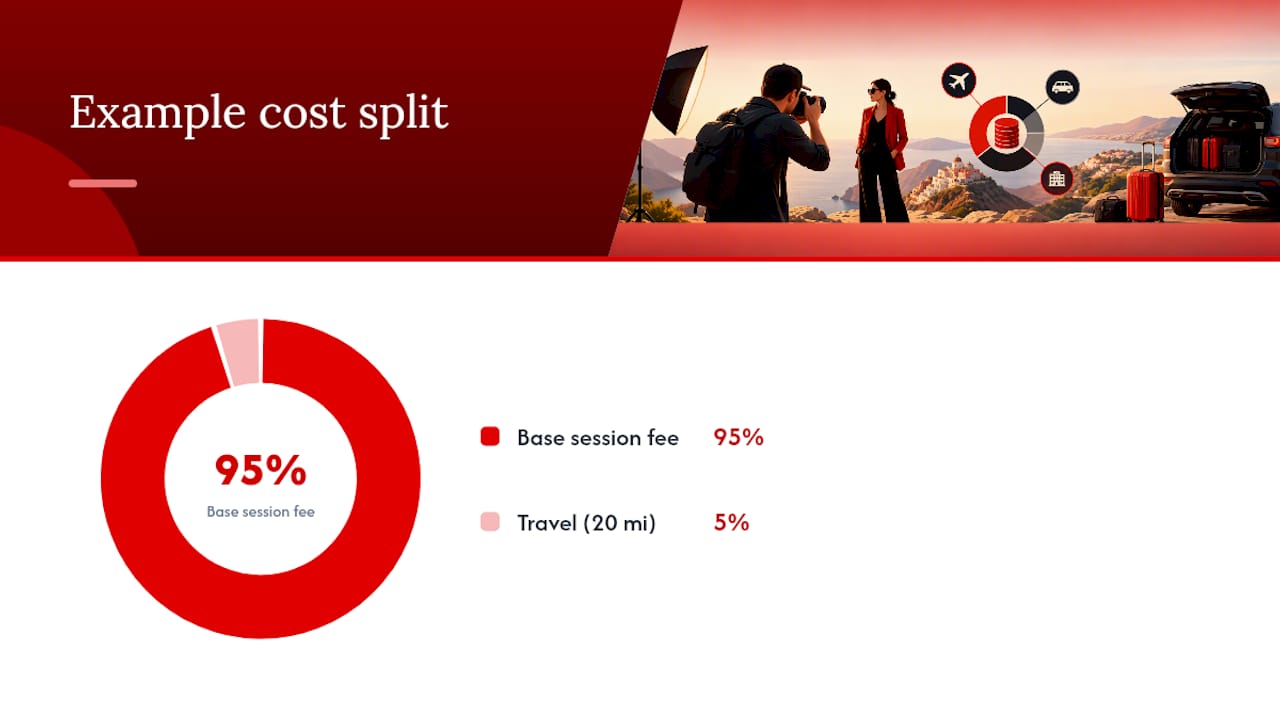
Scenario A, a single professional: a base session fee of $300, similar to Metroplex Headshots’ in-studio session rate, plus a 20-mile round trip billed at the 72.5 cent IRS rate adds about $14.50, landing near $315 total before retouching.
Scenario B, a small team of 10: a flat location and setup fee of $250, plus a per-person rate of $120, brings the total to $1,450 before extras like additional images.
Scenario C, a large corporate visit requiring overnight travel: a day rate of $1,200, plus invoiced flight and hotel costs of roughly $600, plus a $300 setup fee, totals around $2,100 for a single day on-site.
| Scenario | Base fee | Travel component | Setup or extras | Estimated total |
|---|---|---|---|---|
| Individual, local | $300 | $14.50 (20 miles at 72.5¢/mile) | none | $315 |
| Small team (10 people) | $1,200 (10 × $120) | included in flat fee | $250 flat setup | $1,450 |
| Corporate, overnight | $1,200 day rate | $600 flights and hotel | $300 setup | $2,100 |
These numbers move with distance, headcount, and deliverables, but the formula stays the same regardless of scale.
How to read, compare, and negotiate an on-location headshot quote
Before you sign off on a quote, run through a short checklist.
- Confirm how travel is calculated: ask directly whether it’s per mile, a flat fee, or hourly, and get the number in writing.
- Clarify billable time: find out whether setup and breakdown count toward the total or are separate.
- Check retouching and licensing terms: know how many images are included and what an extra image costs.
- Review cancellation and reschedule rules: ask what happens to the travel fee if the date changes.
A few direct questions go a long way: “Is travel charged per mile or a flat fee?” and “What triggers an assistant fee?” are worth asking every photographer you compare. On the negotiation side, consolidating multiple people into one time slot, choosing a location closer to the photographer’s base, accepting fewer final images, or covering your own parking can all shave real dollars off the total. Shifting the shoot time to avoid rush-hour drive time can quietly reduce hourly travel charges too.
Metroplex Headshots’ perspective on transparent travel pricing
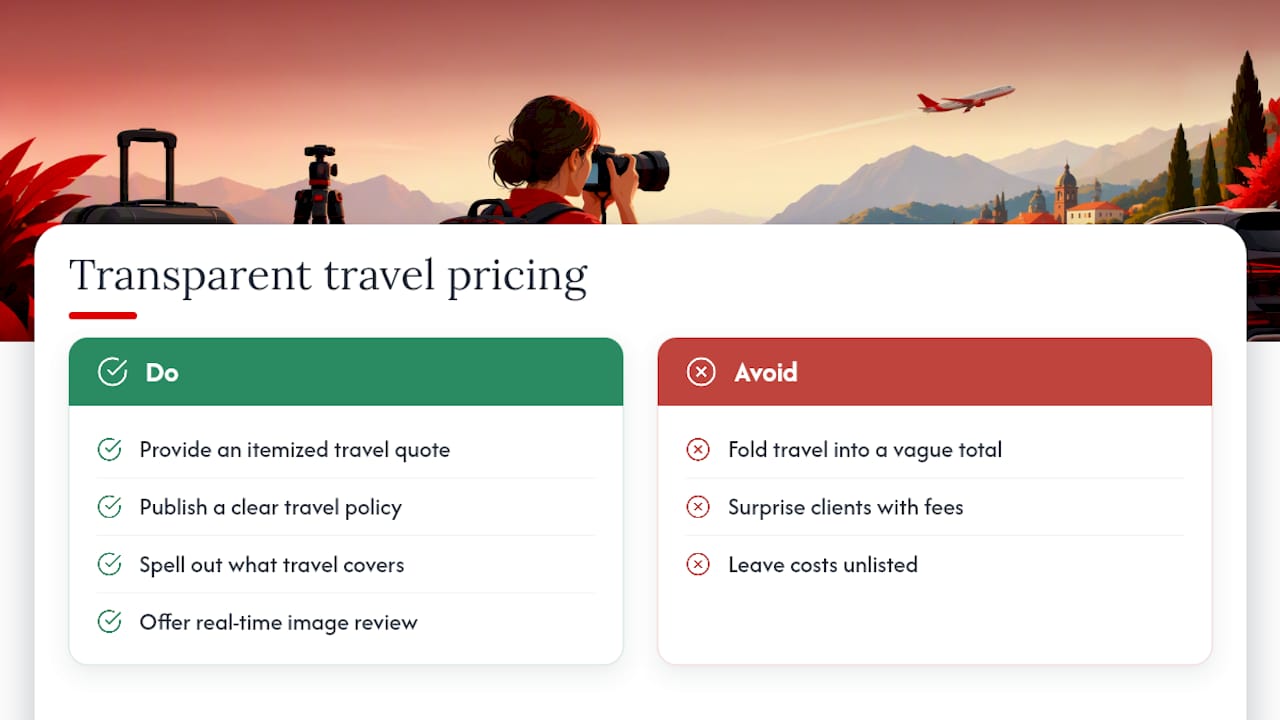
Clear pricing builds trust faster than any portfolio page. When a client can see exactly what a travel fee covers, whether that’s mileage, setup time, or an assistant’s day rate, they stop worrying about the invoice and start focusing on the shoot itself. That’s the standard we hold ourselves to at Metroplex Headshots, whether the session happens in our studio or on-site with a client.
Best practice looks like an itemized quote before the shoot, a stated travel policy so there are no surprises, and real-time image review so clients see results the moment the session wraps. A package that spells out what travel covers, rather than folding it into a vague total, respects the client’s need to plan a budget with confidence. That transparency is what separates a straightforward quote from one that leaves a business guessing.
— Traci Schowmeyer
Booking an on-location session with Metroplex Headshots
Metroplex Headshots offers both in-studio sessions and on-location visits, including company headshot packages built for teams that need a mobile studio brought to their office. Our pricing pages lay out costs upfront rather than hiding travel and setup behind a vague quote request.

When you request a quote, a few details speed things up considerably.
- Share your address or venue so we can calculate distance and setup needs accurately.
- Give us a headcount for the session, since team pricing scales with group size.
- Note your preferred date and time along with any deliverable expectations, such as retouching level or file format.
If your team is spread across multiple offices, our national headshot services page covers how we handle multi-site bookings. Ready for a quote? Visit our packages page to see current pricing and request an itemized breakdown for your location.
Sources
For readers who want to verify these figures directly, the IRS standard mileage rate page covers 2026 rates, the PPA pricing guide explains cost-of-doing-business principles, and photographers looking to grow bookings can explore SEO services for photographers.
- Standard mileage rates | Internal Revenue Service
- Price your photography for a profit | Professional Photographers of America
- Should I Charge a Travel Fee for Portrait/Wedding Photography? – Hunter and Sarah Photography
FAQ
How much do travel fees typically cost for headshots?
Most on-location travel and setup fees commonly fall within a few hundred dollars to $500, depending on distance, group size, and whether the photographer uses a flat rate, per-mile charge, or hourly billing. Some photographers instead build travel into their package price rather than listing it separately.
What is a fair per-mile rate for photography travel?
Many photographers reference the IRS standard mileage rate, which is 72.5 cents per mile from January through June 2026 and 76 cents per mile from July through December 2026, as a benchmark. A quote that lands near this range is generally considered reasonable.
Do photographers charge more for out-of-town locations?
Yes, out-of-town or overnight trips typically add invoiced costs like flights and hotels on top of a day rate, rather than a simple per-mile charge. Local sessions within a photographer’s normal radius often carry little to no travel fee at all.
How much advance notice do photographers need for on-location bookings?
Notice requirements vary by photographer and by the size of the session, but team or corporate bookings that require travel and setup planning typically need more lead time than a single studio appointment. Confirming your date and headcount early helps avoid rush scheduling costs.
Can I negotiate or avoid travel fees entirely?
Some photographers waive travel fees within a set radius or reduce them when you consolidate multiple people into one visit. Choosing a location closer to the photographer’s base, covering your own parking, or accepting fewer final images can also lower the total cost.

