


Expect $75 to $300 per person for group headshots, with the number dropping fast as headcount climbs past 25. Teams under 25 people usually do best on per-person tiered pricing, groups of 25 to 75 can often save money by choosing a half or full day rate, and very large groups typically require a negotiated enterprise program.
TL;DR:
- Volume discounts typically reduce per-person costs from $200 to $300 for small groups to as low as $75 for large enterprise programs.
- Day rates usually become more cost-effective than per-person pricing when a group exceeds 75 employees, offering simplified invoicing and less risk for no-shows.
- Hidden costs such as setup, retouching, travel, and licensing often double or triple the initial quote, so request all-in prices for accurate budgeting.
- For groups between 25 and 75, compare both day rates and tiered per-person prices carefully to find the best deal based on total total cost, not just per-head price.
- Always verify vendor policies on cancellations, no-shows, re-shoots, and usage rights to prevent unexpected expenses and ensure session consistency.
Table of Contents
- What Does Headshot Volume Pricing Actually Look Like?
- Should You Choose a Day Rate or Per-Person Pricing?
- What Add-Ons and Hidden Costs Change Your Total?
- How Much Should 25, 50, or 500 Employees Cost?
- What Should You Ask Before Signing a Vendor?
- Where Metroplex Headshots Fits Into a Volume Program
- What About Usage Rights When You Buy in Volume?
- What Contract Terms Actually Protect You on a Volume Booking?
- The Real Gap in How Companies Shop for Headshot Programs
- Ready to Get a Volume Pricing Proposal?
- Sources
What Does Headshot Volume Pricing Actually Look Like?
“Headshot volume pricing” isn’t an industry term you’ll find on a photographer’s rate card. What you’ll actually see quoted is corporate headshot pricing, group headshot pricing, or per-person volume tiers. All three describe the same thing procurement teams care about: how the per-head cost drops as your group gets bigger, and what that means for your total spend.
The national median for a corporate headshot sits at $200 to $300 per person for smaller sessions, but that figure moves dramatically once you’re booking a team rather than an individual. Published regional bands show the slide clearly: $200 to $300 per head for groups of 5 to 10, dropping to $150 to $225 for 11 to 25 people, $125 to $175 for 26 to 50, and $100 to $150 once you cross 50 people.
Here’s roughly what to expect by band, and what a standard package typically includes at each level:
- 1 to 4 people: $200 to $300 per person. Usually one retouched final image, no group shot, standard delivery window.
- 5 to 10 people: $175 to $250 per person. One to two retouches, informal group option, similar delivery timing.
- 11 to 25 people: $150 to $225 per person. Retouching bundled in, a formal group photo often included, faster turnaround.
- 26 to 75 people: $100 to $175 per person. Volume discount kicks in here; expect a written package with defined retouch counts.
- 76 to 200 people: $85 to $150 per person, often quoted as a day rate divided by headcount instead of a flat per-head fee.
- 200+ people: $75 to $125 per person, almost always negotiated as an enterprise program with multi-site logistics built in.
When you’re reading a photographer’s rate card, look for three numbers before you compare anyone against anyone else: the session fee (a flat charge that covers setup regardless of headcount), the per-head rate, and any minimum booking requirement. A vendor quoting a low per-head number but tacking on a $500 session fee for a 10-person shoot isn’t actually cheaper than a competitor with a higher blended rate and no minimum.
Should You Choose a Day Rate or Per-Person Pricing?
The math flips once your group crosses a certain size, and knowing where that line sits saves real budget.
- Under 25 people: Stick with per-person tiered pricing. Day rates assume a full schedule, and a small group won’t fill enough slots to make the day rate worthwhile.
- 25 to 75 people: This is the gray zone. Run the math both ways. Half-day rates in major metros typically run $1,500 to $3,500, and full days run $3,000 to $6,000. Divide that by your expected headcount and compare it to the per-person tier rate.
- 75+ people: Day rates almost always win here, and they simplify invoicing since you’re paying one number instead of reconciling attendance against a per-head bill.
Day rates also shift risk in your favor. If three people no-show, you’re not refunded for a per-head quote, but you’re also not paying extra to cover empty slots. Per-person pricing bills exactly for who shows up, which some finance teams prefer even when the math is slightly worse.
What Add-Ons and Hidden Costs Change Your Total?
The quoted per-head rate is rarely the number you’ll actually pay. Industry guidance on structuring corporate photo programs points out that add-ons and coordination commonly push all-in costs 1.5 to 2 times higher than the simple per-head quote you started with.
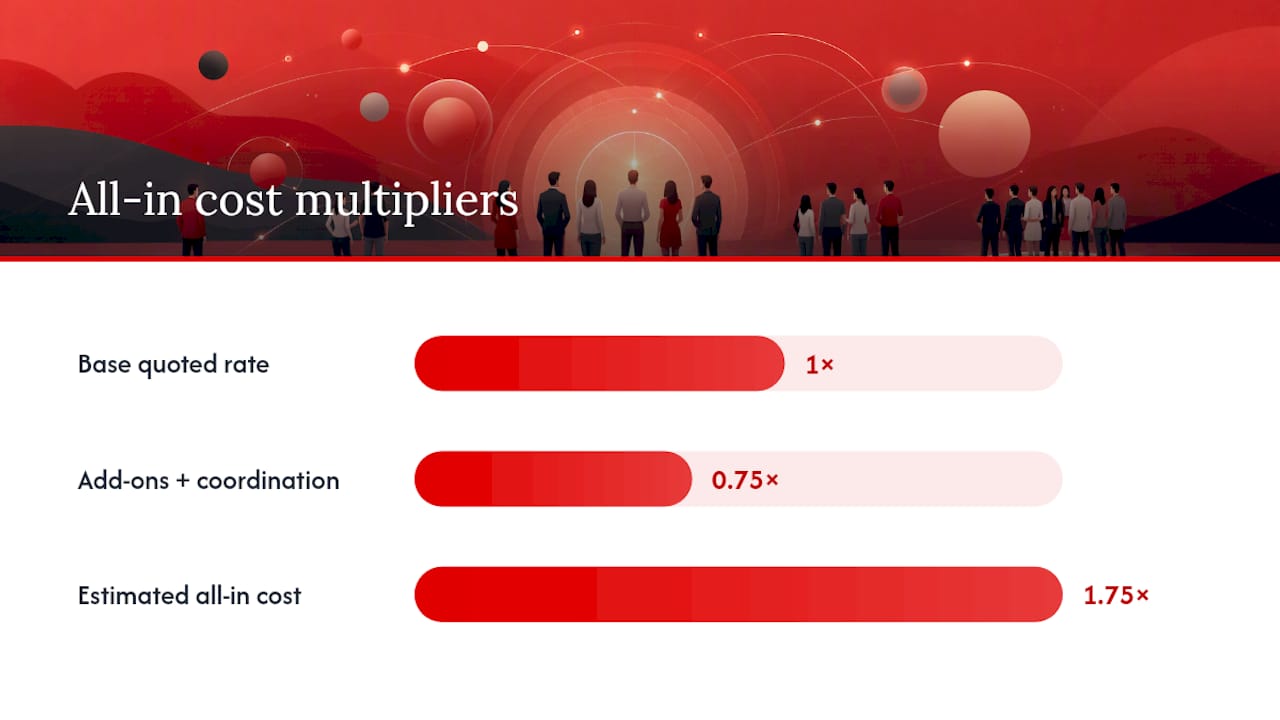
Pro Tip: Ask every vendor for one all-in line item, not a base rate plus a menu of extras. A sentence like “What’s the total per-person cost including setup, one retouch, and standard delivery?” forces an apples-to-apples comparison.
Common line items to budget for:
- Setup and travel: $150 to $500, depending on distance and whether it’s a mobile studio arrangement.
- Extra retouches beyond what’s included: $25 to $75 per image.
- Hair and makeup: $100 to $250 per person, or $300 to $500 flat for a half day.
- Rush delivery: $150 to $300 if you need images turned around in 24 to 48 hours.
- Usage and licensing beyond internal use: $100 to $500 or more, depending on where the images will run.
Internal coordination costs are the piece most budgets miss entirely. Someone on your team has to build the schedule, send reminders, and manage the day of. No-show rates on scheduled corporate shoots commonly run 10 to 25 percent, and recovering those missed sessions with a return visit or individual booking adds real cost on top of your original quote.
How Much Should 25, 50, or 500 Employees Cost?
Numbers get concrete once you attach them to a real headcount. Here’s how the math tends to work at three common program sizes.
| Program size | Format | Per-head range | Add-ons and coordination | Estimated total |
|---|---|---|---|---|
| 25 people | Single-site half day | $150 to $225 | Setup ($200), coordinator time, 10% no-show buffer | $3,000 to $6,000 |
| 50 people | Onsite, multi-hour | $150 to $300 | Retouching bundle, no-show recovery visit | $8,000 to $15,000 first year |
| 500 people | Multi-site enterprise program | $75 to $150 (negotiated) | Program management, travel across locations, annual refresh built in | $37,500 to $75,000 annualized |
The 50-person estimate aligns with published first-year corporate program data. Ongoing annual costs for the same group generally decrease after initial setup and onboarding expenses are no longer incurred.
At 500 people, per-head rates drop, but program management overhead becomes its own line item. Someone needs to schedule across sites, track who’s been photographed, and manage the annual refresh cycle. That’s not a discount you get for free. It’s a cost that shifts from the photographer’s invoice to your internal headcount.
What Should You Ask Before Signing a Vendor?
A low quote means nothing if the vendor can’t deliver consistent images across 50 people or 5 locations. Before you sign anything, work through these questions.
- Operational capacity: How many people can they photograph per hour, and what’s their plan for scheduling and reminders? A half day typically covers 25 to 35 people, a full day 55 to 70, once you build in breaks.
- Deliverables: How many retouches per person are included, what file formats do you get, and what’s the turnaround window?
- Licensing terms: Can your team use these images on LinkedIn, the company website, and press materials without an additional fee?
- Risk and commercial terms: What’s their cancellation policy, their no-show policy, and do they offer a re-shoot if someone’s unhappy with their image?
Pro Tip: Request a folder of 10 recent images from an actual team shoot the vendor completed, not their curated portfolio. Consistency across multiple subjects and sessions is the real test of whether a vendor can handle your headcount.
Where Metroplex Headshots Fits Into a Volume Program
Corporate headshot offerings often include same-day booking and fast delivery, minimizing wait times for images to be available in team directories or LinkedIn profiles. Mobile studio setups can allow photographers to come to your office rather than requiring employees to travel elsewhere.
Here’s how that maps to what you’re evaluating:
- On-location and mobile studio options reduce the travel add-on cost most vendors quote separately.
- Professional retouching and background editing are often included as part of the package, rather than as separate upsells.
- Real-time image review during the session can help reduce reshoot requests after the fact.
- Packaging built for large teams means the pricing structure is already built around headcount tiers rather than one-off individual rates.
For programs spanning multiple offices, the national program page covers how multi-site scheduling and consistency get handled at scale.
What About Usage Rights When You Buy in Volume?
Volume pricing changes more than the per-head number. It often changes what you’re allowed to do with the images afterward, and this is the part procurement teams miss most often.
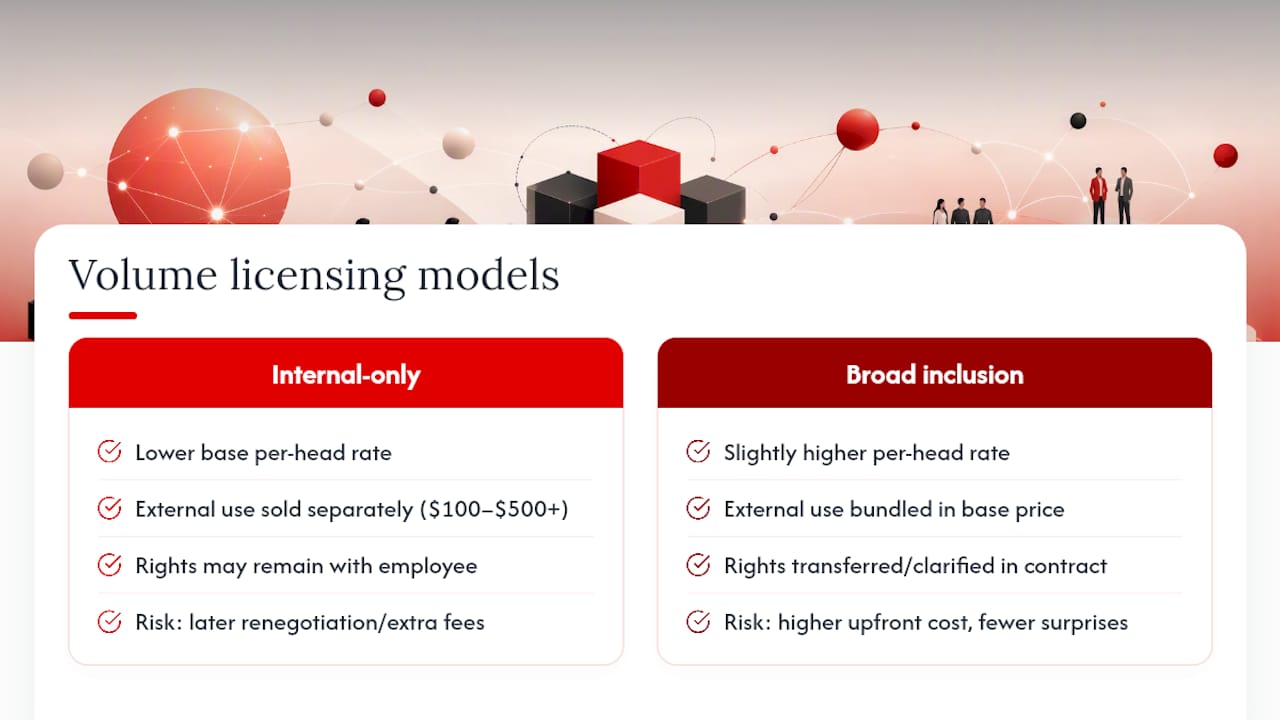
A single freelance headshot session usually includes personal or limited business use, full stop. Corporate volume agreements work differently. Because you’re paying for dozens or hundreds of images at once, vendors typically build usage rights into the contract explicitly rather than leaving it implied. That can mean broad internal use (LinkedIn, intranet, badge photos, internal directories) bundled into the base rate, with external use (press releases, advertising, billboards) priced as a separate license.
The risk runs both directions. Some vendors quote an attractively low per-head rate specifically because usage is restricted to internal purposes only, then charge $100 to $500 or more per image if marketing wants to use a headshot externally later. Others build broad usage into the base program price from the start, which shows up as a slightly higher per-head number but avoids a second negotiation six months down the road.
Before signing, get the usage terms in writing at the same level of detail as the pricing tiers. Ask specifically whether the rights transfer to the company or stay with the individual employee, what happens when someone leaves the company, and whether external use requires a separate fee per image or per campaign. A study on brand consistency points out that fragmented, inconsistently licensed headshots across departments actively undercut how professional a company looks externally, which is exactly the outcome a clear licensing agreement is meant to prevent.
What Contract Terms Actually Protect You on a Volume Booking?
Volume bookings carry more contractual risk than a single headshot session, mostly because more can go wrong across more people and more days. The contract terms that matter most rarely get discussed until something’s already gone sideways.
Cancellation policy is the first thing to pin down. Ask what happens if your company needs to reschedule the entire shoot, not just an individual slot. Some vendors charge a percentage of the total program cost for cancellations inside a certain window, often 48 to 72 hours out. Get that window and that percentage in writing before you sign.
No-show policy deserves equal attention, and it deserves the same clarity as your cancellation terms. If 10 to 25 percent of your team doesn’t show up on shoot day, which published guidance treats as a normal range to plan for, does the vendor offer a return visit at no charge, a discounted make-up session, or nothing at all? This should carry the same specificity as your cancellation clause, not a vague “we’ll try to accommodate” line.
Re-shoot policy matters just as much. If an employee is unhappy with their final image, is a re-shoot included, or does it get billed as a new session? Invoicing terms round out the list: net 30 is standard for corporate programs, but confirm whether payment is due before or after final delivery, and whether multi-site programs get billed per location or as one consolidated invoice.
The Real Gap in How Companies Shop for Headshot Programs
Most companies shopping for headshots compare the wrong number. They ask “what’s your per-head rate?” and stop there, which means they’re comparing quotes that don’t actually cover the same scope. A $150 per-head quote with no retouching included isn’t cheaper than a $200 quote that bundles retouching, a group shot, and same-day delivery. It’s just incomplete.
The conventional advice tells buyers to shop around for the lowest per-person number. That’s backwards. Shop for the lowest all-in cost per usable, on-brand image, because that’s the number that actually shows up in your budget once coordination time and no-show recovery get added in. A vendor quoting a slightly higher rate with tighter scheduling, built-in retouching, and a real cancellation policy will almost always beat the cheap quote once the hidden costs surface three weeks into the program.
If there’s one thing procurement teams should prioritize first, it’s asking for that all-in number before comparing anyone against anyone else. Everything else, from usage rights to re-shoot policy, matters, but it only matters once you’re comparing quotes that mean the same thing.
— Traci Schowmeyer
Ready to Get a Volume Pricing Proposal?
Once you know roughly what your program should cost, the fastest path forward is getting an actual quote rather than guessing from published ranges. Metroplex Headshots builds corporate proposals around your specific headcount and sites rather than a generic rate card, which means the number you get back reflects your actual program instead of a national average.

To get an accurate proposal, have four things ready: your total headcount, the number of office sites involved, the deliverables you need (LinkedIn-ready files, badge photos, a company directory shot), and your timeline. Metroplex Headshots works from a mobile studio kit that travels to your office, uses a consistent lighting and background setup across every session so images look uniform regardless of who’s behind the camera that day, and delivers finished, retouched images fast rather than making your team wait weeks.
Review the corporate team package details for a sense of how packages are structured, or check the national program page if your team spans multiple cities. From there, request a proposal with your headcount and timeline, and you’ll have a real, itemized number instead of a published range to plan against.
Sources
- How to shoot corporate headshots on site — PhotographyTalk
- Commercial Headshot Business Playbook (B2B Guide 2026) – Tov Studio Photo

