


Why Your Headshot Matters More Than You Think
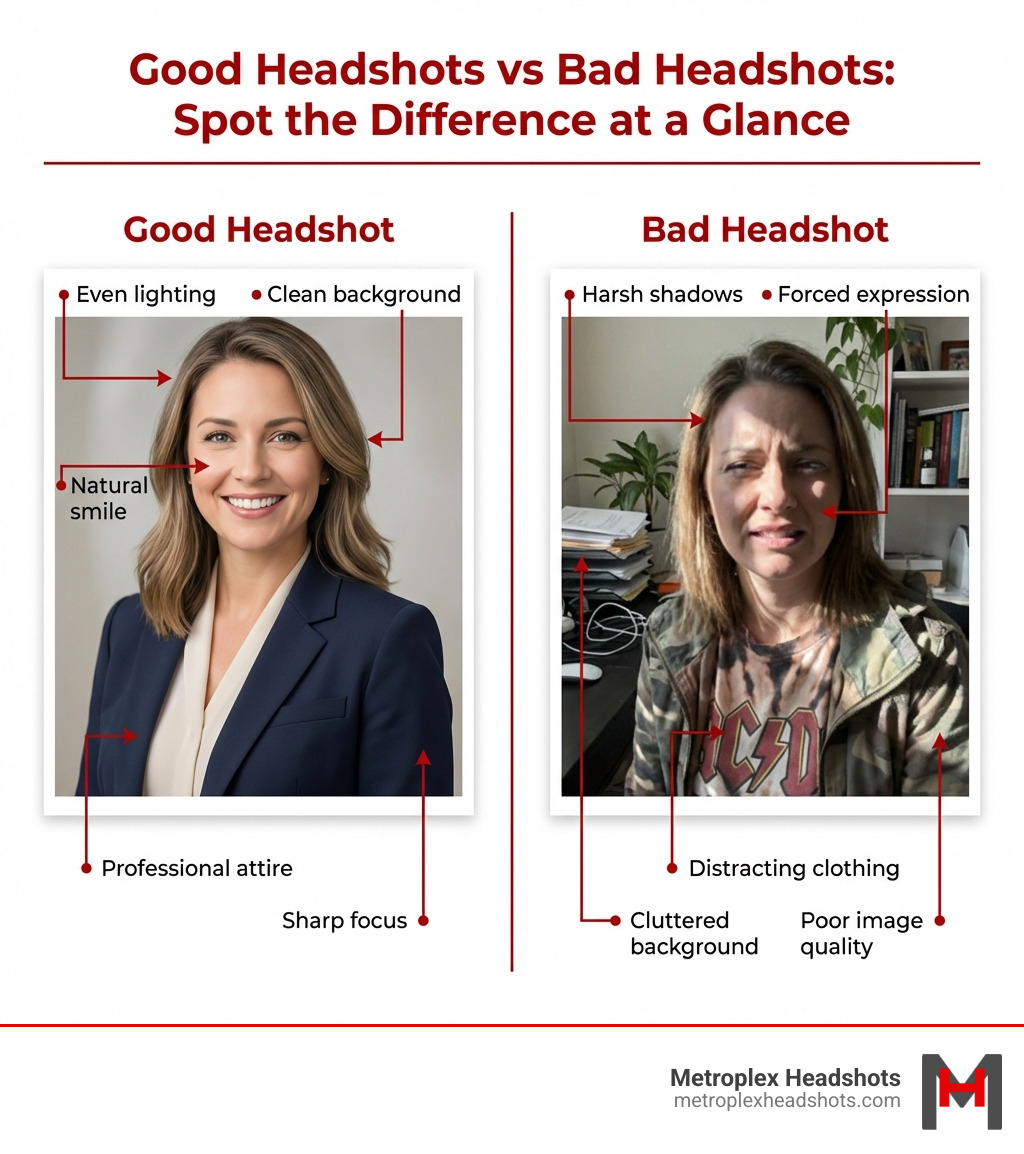
Understanding good headshots vs bad headshots is crucial for anyone serious about their professional image. The difference often comes down to a few key elements:
| Good Headshot | Bad Headshot |
|---|---|
| Even, flattering lighting that sculpts the face | Harsh shadows, flat lighting, or direct sunlight |
| Genuine, confident expression with engaged eyes | Forced smile, stiff pose, or vacant stare |
| Clean, simple background that doesn’t distract | Busy patterns, distracting objects, or poor cropping |
| Professional wardrobe in solid, appropriate colors | Logos, busy patterns, or outdated styling |
| Sharp focus with high resolution | Blurry, pixelated, or low-quality image |
| Current appearance that matches how you look today | Outdated photo or heavy retouching that hides you |
Your headshot is your digital handshake. It’s the first thing people see on LinkedIn, your company website, or your email signature. In seconds, viewers judge your professionalism, competence, and trustworthiness based on that image.
The problem? Most people don’t realize what’s off about their current photo. They reuse a dated studio shot, crop a social media photo, or attempt a DIY headshot with uneven lighting and awkward framing. In high-stakes moments like client pitches, job interviews, or networking events, those small visual signals matter enormously.
A good headshot builds trust and opens doors. A bad one quietly costs you opportunities before you even get a chance to speak.
I’m Traci Schowmeyer, owner of Metroplex Headshots, and I’ve captured professional portraits since 1999. For decades, I’ve learned what separates good headshots vs bad headshots and helped everyone from new hires to Fortune 100 C-Suite executives present their best professional image.
The Anatomy of a Headshot: Good Headshots vs. Bad Headshots
When we talk about headshots, we’re not just discussing a picture; we’re talking about a visual representation of your personal brand. It’s a powerful tool that, when done right, can significantly impact your career trajectory and how others perceive you. The distinction between good headshots vs bad headshots isn’t merely aesthetic; it’s about effectiveness and impact.
Key Differences in Good Headshots vs. Bad Headshots
Let’s break down the fundamental differences that lift a headshot from merely a photo to a powerful professional asset. A good headshot always prioritizes professionalism and competence, ensuring that it makes sense for the type of work you do. For professionals, it should convey an image that aligns with your industry, making you appear capable and trustworthy. For actors, a great headshot is one that gets auditions or work, reflecting how seriously you take your career.
Here’s a detailed look at what sets them apart:
| Criteria | Good Headshot | Bad Headshot |
|---|---|---|
| Lighting | Even, flattering, sculpts the face, creates catchlights in eyes | Harsh shadows, flat lighting, overexposure, “monster lighting” |
| Expression | Genuine, confident, approachable, eyes engaged and expressive | Forced smile, stiff, uncomfortable, vacant stare, unapproachable |
| Background | Clean, simple, neutral, blurred (bokeh), complements subject | Busy, distracting, cluttered, inappropriate, causes unflattering shadows |
| Wardrobe | Professional, solid colors, appropriate for industry, well-fitted | Logos, busy patterns, outdated, wrinkled, ill-fitting, distracting |
| Quality | Sharp focus, high resolution, clear, professionally edited | Blurry, pixelated, low resolution, poorly cropped, over-filtered |
| Authenticity | Accurately represents current appearance, looks like “you” | Outdated, heavily retouched, doesn’t match real-life appearance |
A good headshot builds trust because it feels effortless and authentic. The lighting works, the background fades, and your expression is natural. Bad headshots, on the other hand, can quietly cost you opportunities. Even if no one can explain what’s wrong, they sense it, influencing whether they click, reply, or move on, because people make snap judgments based on appearance in just seconds. This gut reaction can prevent you from getting your foot in the door. The power of The Power of First Impressions: How a Great Headshot Can Make a Difference cannot be overstated.
Common Mistakes That Lead to Bad Headshots
Many professionals unknowingly sabotage their image with headshots that miss the mark. We’ve seen countless examples of common pitfalls that prevent a headshot from serving its purpose effectively.
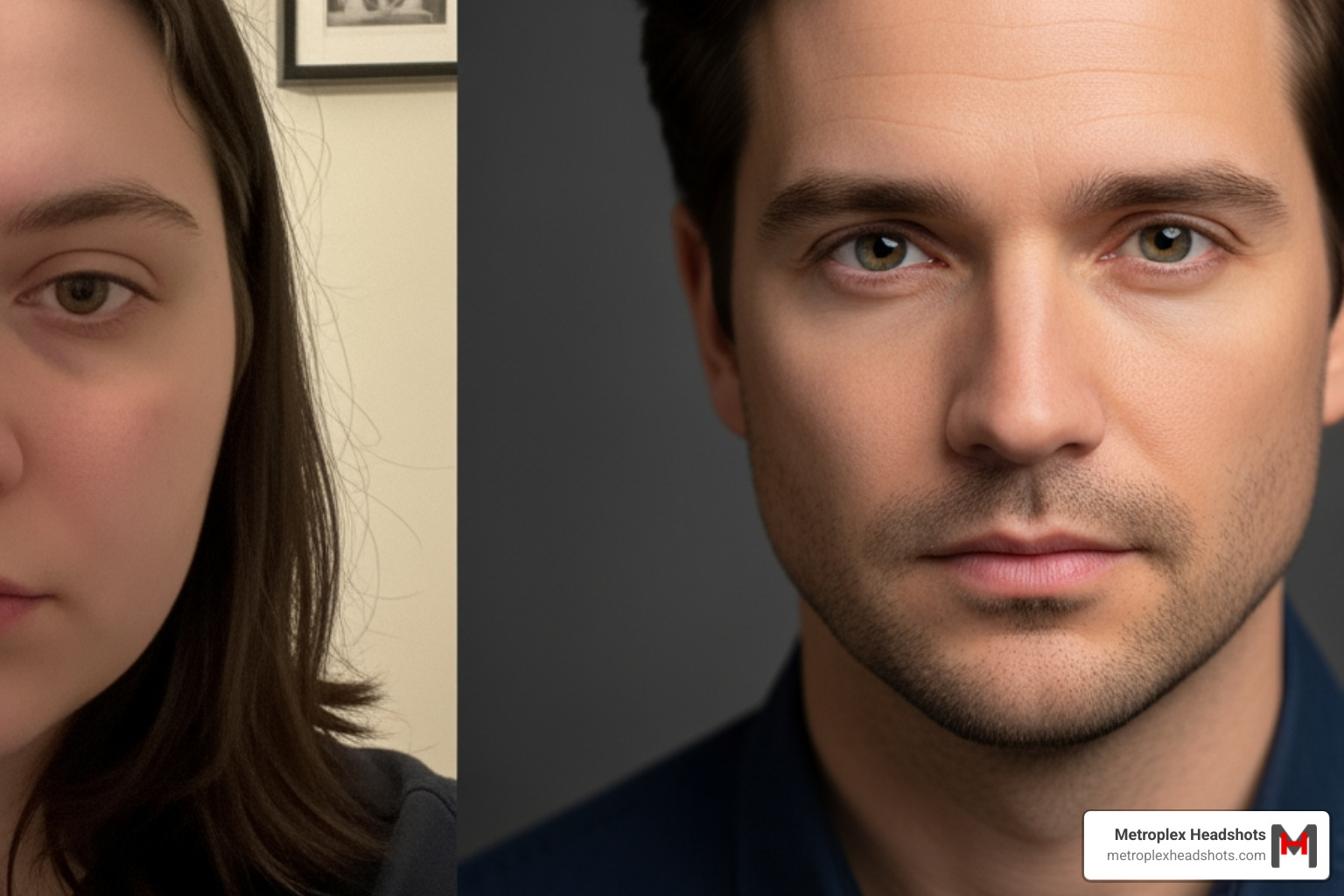
One of the most frequent errors we encounter is the poorly cropped selfie or casual photo. We’ve gone through hundreds of submissions and recall seeing dozens of headshots where individuals had “no foreheads whatsoever,” or where ears, chins, or eyebrows were cropped out. This “stylish amputation” of features, as one expert called it, is a significant cropping mistake. These distracting backgrounds, extreme crops, or harsh filters pull attention away from your face and toward all the wrong things.
DIY headshots often fall victim to awkward framing and uneven lighting. While the intention might be to save time or money, the lack of professional equipment and expertise usually results in a photo that looks unprofessional. These images frequently feature distracting backgrounds, such as a busy office, a cluttered home, or even the dreaded garage door. We’ve seen headshots with such generic or undesirable backgrounds that they detract from the subject entirely.
Another common mistake is using an outdated appearance. If your headshot is from five years ago and your hair color, style, or even glasses have changed, it’s time for an update. The number one piece of advice we’ve heard from casting directors (and it applies to all professionals) is to “LOOK LIKE YOUR HEADSHOTS!” If you show up looking different than your headshot, it hurts your chances of making a genuine connection.
Finally, heavy retouching and unnatural posing can render a headshot ineffective. Too much skin smoothing removes texture and authenticity. Over-sharpened eyes or dramatic shadows can create an “uncanny effect.” A stiff, forced smile shows zero personality and makes you seem unapproachable. The goal is to look like your best, most current self, not an airbrushed version that doesn’t quite match reality.
Technical Triumphs vs. Technical Fails: Lighting, Framing, and Background
A great headshot isn’t just about a pretty face; it’s a careful blend of technical precision and artistic vision. When every element—lighting, framing, and background—works harmoniously, the result is an image that feels effortless, allowing your personality to shine through. Conversely, technical failures can create friction, pulling attention away from you and toward what’s “off” in the photo.
The Role of Professional Lighting
Lighting is arguably the most critical element in headshot photography. It can make or break an image, changing a simple portrait into a compelling visual statement.
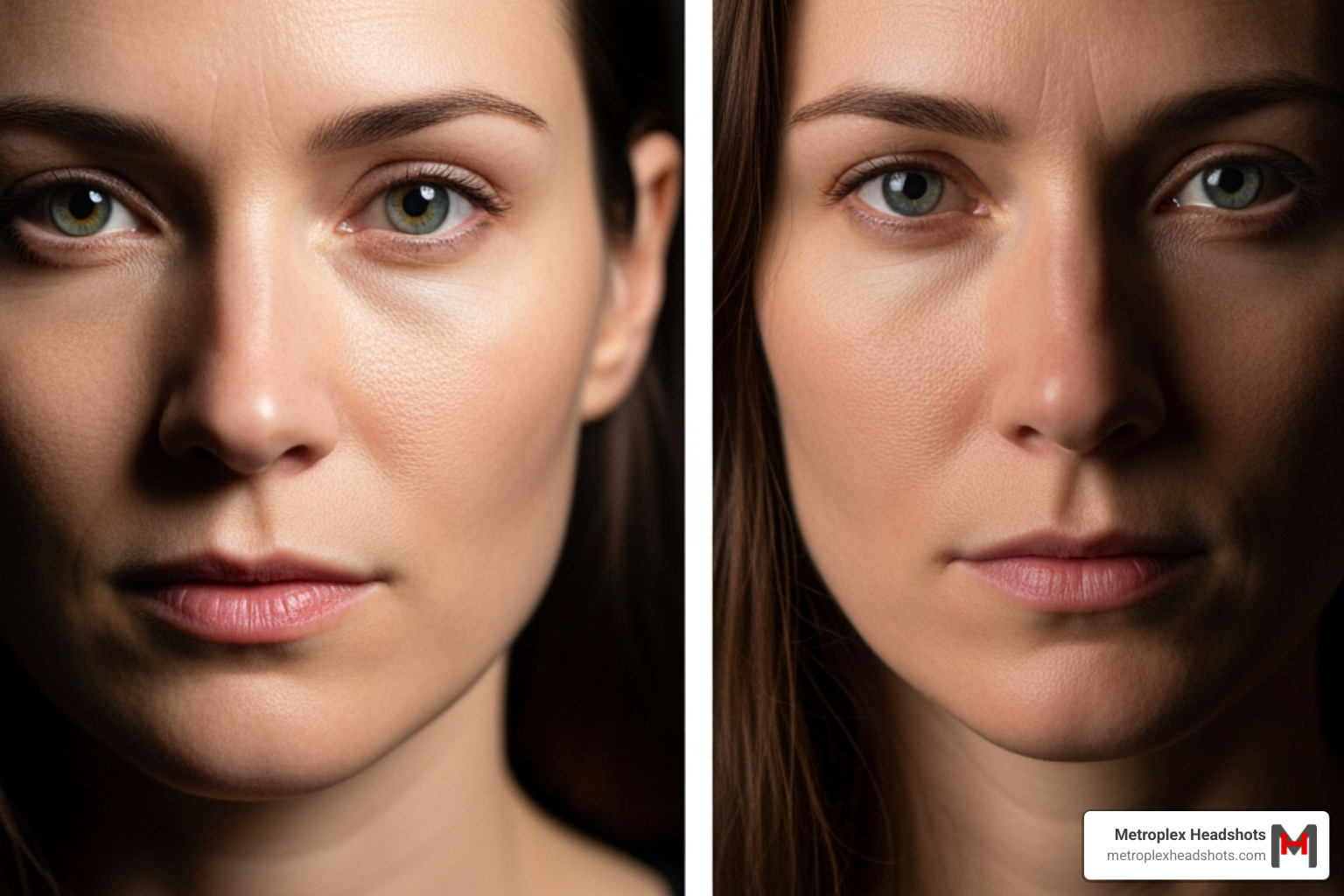
Good lighting is flattering and sculpts the face, adding dimension and depth that a two-dimensional image often lacks. We aim for soft, even illumination that highlights your best features, creates subtle shadows beneath the chin and jawline, and places bright “catchlights” in your eyes, making them sparkle and appear lively. This type of controlled lighting makes it easy for viewers to focus on your face, not on the camera setup. Our studio in the Dallas-Fort Worth Metroplex is equipped to achieve this consistently. You don’t notice the lighting because it’s working seamlessly. For more insights, check out this guide to headshot lighting.
Bad lighting, however, can be disastrous. Harsh shadows can obscure features, create unflattering lines, or even give a distorted appearance. “Cross-lighting,” where two lights are placed on either side of the camera, can create unflattering shadows on both sides of the face. “Flat lighting” can wash out skin details and overexpose certain areas, making the face appear less sculpted. And then there’s what we affectionately call “monster lighting”—unflattering light coming from too far underneath the chin or reflections from bright surfaces like sidewalks, which can make you look like you’re telling a scary story around a campfire. Harsh outdoor sunlight, while seemingly natural, can accentuate skin imperfections and cause squinting, leading to an uncomfortable or strained expression. We understand that “sunlight is bluer than most artificial light,” and mixing them can lead to an undesirable color cast.
While natural light can give headshots a very real, “film” look, controlling it requires expertise. Professional studio lighting, on the other hand, offers consistent, repeatable results, ensuring every shot is perfectly illuminated.
Framing and Composition That Focuses on You
How a headshot is framed and composed dictates where the viewer’s eye goes and what message the image conveys. Our goal is always to keep the focus squarely on you.
Most effective headshots use a chest-up framing, allowing enough of your body to show a general sense of your shape and size, but keeping the attention on your face and expression. We avoid extreme close-ups, which can be too intense or limiting.
One of the most powerful compositional tools we use is the “rule of thirds.” This principle suggests that if you place points of interest along intersecting lines or at their intersections within a grid, your photo will be more balanced and engaging. In a headshot, your eyes are the most important elements, so we often position them along these lines to draw the viewer in. Applying the “rule of thirds” to your headshots allows for better focal points and a more dynamic image.
Conversely, poor framing can lead to significant cropping mistakes. We’ve seen countless examples of “amputating” features—headshots where the top of the head is cut off, or where ears and chins are awkwardly cropped out. These tight crops make the image feel constrained and can inadvertently remove crucial identifying features. Your headshot should clearly display your full face and essential features, ensuring there’s enough headroom without excessive empty space. We believe that Beyond the Snapshot: How Professional Headshots Shape Your Success in DFW is achieved through meticulous attention to these details.
Choosing a Background That Complements, Not Distracts
The background of your headshot should always complement you, never distract from you. It’s about creating a harmonious setting that allows your face to be the star.
We generally opt for neutral backgrounds—solid colors like gray, white, or black—that provide a clean, uncluttered canvas. White backdrops are excellent for creating contrast, while black backdrops, with balanced lighting, can create a very powerful and sharp professional look. Using a seamless paper backdrop in our studio ensures a consistently smooth and professional finish.
A blurred background, often called “bokeh,” is another effective technique. By using a lens that completely blurs the background, we can ensure that any elements behind you fade into a soft, pleasing wash of color, keeping the focus entirely on your face. This is particularly useful for environmental portraits, where we might want to hint at your workspace or industry without it becoming a busy distraction.
What makes a background bad? Distracting backgrounds, busy patterns, or inappropriate settings pull attention away from your face. Generic or undesirable backgrounds like stucco walls or garage doors are common culprits, as they scream “amateur” and detract from your professional image. Imagine the humor in an overly exaggerated aversion to a garage door background – “Oh no! Not the garage door! No! No! Get it away from me! Noooooooooo!” It’s a common pitfall that’s easily avoided with professional guidance.
Our approach to Crafting Your Professional Image: The Importance of Headshots in the DFW Metroplex ensures that your background choice strategically reinforces your brand, rather than undermining it.
The Human Element: Expression, Connection, and Styling
While technical excellence provides the foundation, the true magic of a great headshot lies in its ability to capture your unique personality, connect with the viewer, and tell your story. This human element is what truly differentiates good headshots vs bad headshots.
Expression and Eye Contact: The Window to Your Brand
Your expression and eye contact are paramount. They are the windows to your brand, conveying approachability, confidence, and authenticity.
A good headshot features a genuine, confident expression. It’s a look that says, “I’m capable, I’m approachable, and I’m ready to connect.” Your eyes should be engaged, making direct contact with the camera, as if you’re speaking directly to the viewer. This creates a powerful sense of connection and trustworthiness. We know that your eyes are the most important elements of your headshot, and they should be your “points of interest.”
On the flip side, a bad headshot often displays a forced smile, a stiff pose, or a vacant stare. If your expression looks even the remotest bit uncomfortable or your smile looks fake, viewers will notice. A forced smile shows zero personality and doesn’t make eyes linger; it can make you appear unsure or even unapproachable. We’ve also seen “dead eyes” or a “glazed over” look that fails to convey any inner thought or personality. It’s a fascinating fact that research shows we can’t necessarily see our own facial expressions and body language objectively, which is why a professional photographer’s guidance is so invaluable in drawing out your most authentic self. At Metroplex Headshots, we specialize in making you comfortable in front of the camera, helping you relax and achieve that genuine, confident look.
Clothing and Styling: Dressing for Your Goals
Your wardrobe choices in a headshot are not just about fashion; they’re strategic decisions about how you want to be perceived. It’s about dressing for the job you want, not just the one you have.
For good headshots, we recommend solid colors that complement your skin tone and eye color. Simple, basic, plain options ensure the focus remains on your face and features, rather than distracting prints on your clothes. Clothing should be well-fitted, professional, and appropriate for your industry. For men, dark suits (navy or gray) are often recommended, with tie colors that complement the suit and shirt. For women, avoiding stark white (unless layered under a jacket), ensuring jewelry is subtle and complementary, and opting for fitted shirts or dresses are key. Bare arms are generally not recommended for executive headshots as they can distract. We understand that Headshots for Every Stage of Your Career: Graduates to CEOs require careful consideration of attire.
Bad headshots often feature busy patterns, prominent logos, or outdated styling. Distracting backgrounds, bold prints, or a busy shirt pattern can pull attention away from your face. Tight grid-like patterns can even have a weird effect on camera. Wearing clothing with writing or logos can make your headshot feel less professional. We advise against anything that clashes with your role or makes you seem out of touch. The key is to think closely about your audience and what you want to tell people with your headshot. Professionalism doesn’t look the same everywhere; a crisp black blazer might signal authority in law but feel cold in wellness.
The Actor vs. The Executive: Different Needs, Different Shots
While the core principles of good headshots vs bad headshots remain consistent, the specific objectives and stylistic nuances differ significantly depending on your profession.
Here are the key differences:
- Actor Headshots:
- Purpose: To get auditions and work. Casting directors look for versatility and “type” (e.g., leading lady, character actor, comedic relief).
- Expression: Often more varied, showcasing range of emotion and personality. Eyes are crucial for conveying inner thoughts and a backstory.
- Wardrobe: Simple, non-distracting clothing that suggests “type” without being a costume. Minimal makeup to show the natural self, allowing for character change.
- Background: Typically simple, neutral, or slightly textured to keep the focus entirely on the actor’s face and expression.
- Authenticity: Must accurately reflect current age and appearance to avoid disappointment at auditions. “LOOK LIKE YOUR HEADSHOTS!” is the mantra.
- Executive/Corporate Headshots:
- Purpose: To convey competence, trustworthiness, and approachability for business and professional networking.
- Expression: Confident, professional, and engaging, often with a warm, genuine smile. The goal is to build trust and credibility.
- Wardrobe: More formal attire (suits, blazers, professional blouses/shirts) in solid, conservative colors. The style should align with the company’s brand and industry standards.
- Background: Clean, consistent, and often neutral studio backgrounds or subtle office environments that reinforce professionalism.
- Authenticity: Must reflect the current professional image, signaling a commitment to one’s career and brand.
Understanding these distinctions is vital. A dramatic, smoldering stare might be perfect for an actor’s headshot, but it would be inappropriate for an attorney. Similarly, a pastel backdrop and floral blouse might feel creative but could clash in a finance professional’s headshot. We specialize in tailoring our approach to your specific professional needs, ensuring your image aligns perfectly with your goals. Explore Beyond the Suit: How Headshots Differ for Corporate Executives and Business Professionals for more insights.
The Modern Dilemma: Real Photography vs. Digital Alternatives
In today’s fast-evolving digital landscape, new technologies are constantly emerging, promising quick and affordable solutions for everything, including headshots. This has led to a modern dilemma: the choice between traditional, real photography and digital alternatives, particularly AI-generated images. When evaluating good headshots vs bad headshots, it’s important to understand the nuances of these options.
The Pros and Cons of Digital Headshot Alternatives
Digital headshot alternatives, often leveraging artificial intelligence, have gained popularity for their speed and cost-effectiveness. These services promise to deliver numerous “hyperrealistic” headshots in minutes, custom to specific roles and styles. For some, the idea of getting up to 200 high-quality images without a traditional photoshoot seems like a dream come true.
However, these alternatives come with significant drawbacks. While they can produce aesthetically pleasing images, they often fall into what’s known as the “uncanny valley”—images that are almost human-like but have subtle imperfections that make them unsettling or inauthentic. AI-generated headshots can alter facial proportions, smooth out details too much, or create an unnatural, overly polished look that doesn’t quite resemble the real you. This can lead to a lack of authenticity, which quietly undermines trust.
Furthermore, the industry itself is struggling with the ethical implications of AI. For actors, using AI-generated headshots can be particularly problematic; some casting directors can instantly spot them, and there’s a risk of being “blacklisted” due to concerns about AI replacing human talent. The SAG-AFTRA strikes over AI use highlight the industry’s stance. For any professional, an AI headshot can inadvertently signal a lack of investment in their personal brand or a detachment from reality. We believe that An AI Headshot Versus a Real Headshot: Reasons Why the Difference Matters is a crucial conversation for professionals today.
Why Authenticity Still Wins
Despite the allure of digital shortcuts, authenticity remains the gold standard for good headshots vs bad headshots. A genuine, human-captured photograph builds trust in a way that AI simply cannot replicate.
When your headshot is a true representation of you, it fosters credibility and connection. Your image should accurately portray your current appearance, ensuring that when you meet someone in person, they recognize you instantly. The common advice to “LOOK LIKE YOUR HEADSHOTS!” is paramount. If you show up looking different from your photo, it can significantly hurt your chances of making a positive impression, as it creates a disconnect and erodes trust. Over-retouching, whether by a human or AI, changes how you look and can lead to fewer opportunities because you don’t match the expected image.
This is where the value of a human photographer shines. At Metroplex Headshots, we pride ourselves on making clients comfortable in front of the camera, specializing exclusively in headshots, and delivering confident, natural-looking images quickly, often with same-day selection. A professional photographer doesn’t just operate a camera; we guide you, help you relax, and draw out your most authentic expressions. This human interaction is crucial for capturing the nuances of your personality and ensuring your headshot is not just technically perfect, but genuinely you. As one expert put it, “A photographer who… vibes well with you so you can relax” is key. We understand why you should avoid using A.I. for headshots and instead invest in a real connection that translates into a trustworthy image.
Frequently Asked Questions about Good Headshots vs. Bad Headshots
We often hear similar questions from professionals in the Dallas-Fort Worth Metroplex about their headshots. Here, we address some of the most common inquiries to help you understand the path to a truly effective image.
How often should I update my headshot?
We recommend updating your headshot every 1-2 years, or anytime your appearance changes significantly. This includes major changes in hairstyle, facial hair, getting new glasses, or significant weight fluctuations. The goal is always to ensure you “look like your headshot.” An up-to-date photo is critical for building trust and ensuring that when someone meets you, they instantly recognize the person from your professional profile. If you hesitate to share your current headshot for professional purposes, or if it no longer reflects your current professional level and confidence, it’s definitely time for an upgrade.
How much does a professional headshot cost?
Investing in a professional headshot is investing in your personal brand and career. The costs for professional headshots can vary, reflecting the photographer’s expertise, the length of the session, the number of outfit changes, and the quality of the final retouched images. While we cannot provide specific pricing here, we encourage you to view our transparent pricing options to understand the value and packages we offer. A professional headshot is a strategic expense, not just a casual photo. You can find detailed information on our services and investment levels by visiting our packages page.
Can I take a good headshot with my phone?
While smartphone cameras have indeed come a long way, they often cannot replicate the quality and control of a professional photography setup. Issues like lens distortion (especially with front-facing cameras), limited control over professional lighting, and the inability to achieve a truly professional background blur make DIY phone shots a risky choice for a high-stakes first impression.
For instance, the back lens of most smartphones has significantly higher resolution than the front “selfie lens.” Even if you try to use the back camera, controlling the lighting to avoid harsh shadows or “monster lighting” is challenging without professional equipment. Using your phone’s built-in flash, for example, is almost always a recipe for harsh, unflattering light. While a friend might help with angles, they typically lack the expertise to guide posing, expression, and technical settings to achieve a truly polished result. For critical professional use, relying on a phone for your headshot is often a gamble that could undermine your perceived professionalism.
Conclusion: Invest in Your First Impression
As we’ve explored the nuances between good headshots vs bad headshots, it becomes clear that a great headshot is far more than just a picture; it’s a strategic career tool. It communicates your professionalism, confidence, and personal brand in a single, impactful glance. By understanding the critical elements of lighting, framing, background, expression, and styling, you can avoid common pitfalls and ensure your image works for you, not against you.
In today’s competitive professional landscape, your headshot is often your very first impression, influencing how others perceive your competence and trustworthiness. Don’t let a subpar image quietly cost you opportunities. For professionals in the Dallas-Fort Worth area, including Southlake, Westlake, Trophy Club, Grapevine, Dallas, Plano, Frisco, Colleyville, Hurst, Bedford, Fort Worth, Lewisville, Coppell, Irving, McKinney, and Roanoke, Texas, Metroplex Headshots specializes in creating authentic, confident, and natural-looking images that open doors. We’re here to help you present the best version of yourself, ensuring your headshot is an asset, not a liability.
Ready to lift your professional image? Ask a professional photographer your questions today.

