

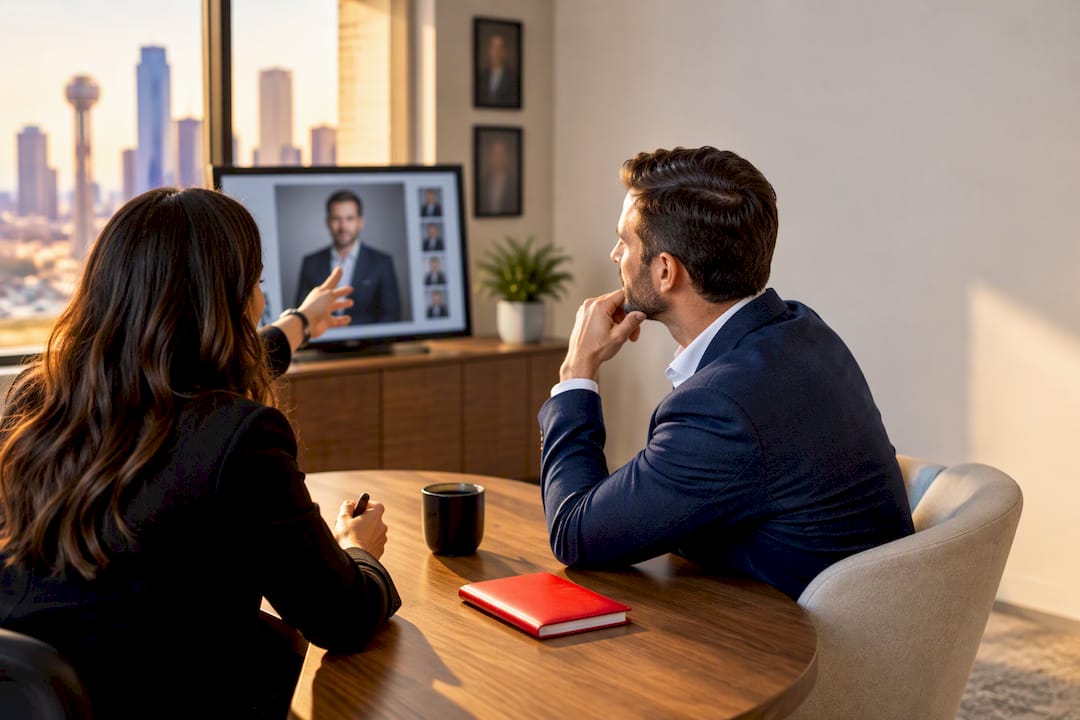
Ask about intended use, portrait style, in-studio versus on-location logistics, session length and outfit changes, number of final images and file formats, retouching scope, and pricing breakdown. These seven questions form a quick checklist you can run through on a booking call or in a single email, and they will surface almost every detail that separates a smooth session from a frustrating one.
TL;DR:
- Most headshot sessions are best kept within a 30-minute window to allow for multiple outfits, poses, and proper pacing.
- Confirm whether the photographer offers proofs before final images and whether licensing includes commercial or online use to avoid surprises later.
- For on-location shoots, check if the space has enough light, power, and a controlled background, and consider weather contingency plans.
- Wardrobe choices should favor solid, well-fitted clothing that complements skin tone, with professional styling recommendations and backup options on hand.
- Real-time feedback and clear communication during the session help ensure expressions and poses align with your brand message, reducing the need for reshoots.
Table of Contents
- 1. What questions should you ask first?
- 2. How do you nail down timing and session structure?
- 3. What should you confirm about files and usage rights?
- 4. Which wardrobe and grooming questions get you camera-ready?
- 5. How do you brief the photographer on your brand?
- 6. What retouching and approval questions protect the final look?
- 7. What belongs on your day-of prep checklist?
- 8. Which Metroplex Headshots resources help you prepare?
- 9. How do you evaluate a photographer’s experience and portfolio?
- 10. What should you ask about lighting style and setup?
- 11. How do you give feedback during the shoot?
- The one question that tells you everything
- How Metroplex Headshots fits into your consultation plan
- Sources
- FAQ
1. What questions should you ask first?
Start with purpose. Asking, “Where and how will I use these images?” tells the photographer whether you need a tight LinkedIn crop, a wide executive portrait for a website banner, or both. That single answer shapes lighting, composition, and even wardrobe advice, so it belongs at the top of every consultation.
From there, move into style. A useful phrasing is, “How do you approach portrait style for someone in my industry?” A lawyer usually wants a formal, still expression with a neutral background, while a real estate agent often benefits from a warmer, more approachable look. Photographers who specialize in corporate work should be able to describe those distinctions and show samples, a point echoed in guidance on what to ask before a headshot session.
Logistics come next, and they matter more than most people expect.
- Ask, “Is this session in-studio or on-location?” Studio work generally gives you controlled, consistent lighting; on-location shoots offer a branded backdrop but depend on available space and power.
- Ask, “How long will the session run, and how is that time split between poses and outfit changes?” Knowing the pace helps you plan your day and avoid rushing.
- Ask, “How many outfit changes are realistic in this time slot?” This keeps expectations grounded before you pack your wardrobe bag.
- Ask, “How many final images will I receive, in what file types, and how will they be delivered?” Some photographers hand over digital galleries, others send files directly, and the 10 Questions to Ask a Headshot Photographer guide points out that proofs are often provided before final selections are made.
- Ask, “What is included in the session fee, and what costs extra?” Additional images, expedited delivery, and expanded licensing frequently carry separate charges, a detail worth confirming per the pricing checklist in 17 Questions To Ask a Prospective Headshot Photographer.
Running through these five questions before you book means fewer surprises on session day and a clearer sense of what you are actually paying for.
2. How do you nail down timing and session structure?
Session length is not just a number on a booking form, it is the raw material the photographer works with. Ask how the time will be divided between setup, posing, and outfit changes so you know whether a 30 minute slot realistically covers two looks or one.
For on-location shoots, confirm the practical details before the crew arrives.
- Ask whether the space has enough room and power for lighting equipment, and whether the background can be controlled or will show office clutter.
- Ask if the photographer offers real-time proofing during the session, so you can see and approve shots before moving to the next setup.
- Confirm arrival time, parking instructions, and which room or area will be used.
- Ask what the contingency plan is if weather affects an outdoor or on-location session.
Studio sessions remove most of these variables since lighting stays consistent regardless of the day outside, which is one reason many corporate clients default to studio bookings for team projects.
Pro Tip: Ask for a rough shot list or timeline before the session starts. It keeps everyone on the same page when the clock is running.
3. What should you confirm about files and usage rights?
The gap between a great session and a frustrating one often shows up after the shoot, when files finally land in your inbox. A few direct questions close that gap before it opens.
- Ask how many final, retouched images are included in your package and whether you will see proofs first.
- Confirm the file formats you will receive, and ask specifically if a PNG transparent version or web-sized files are available for online use.
- Ask whether the licensing covers commercial use, editorial use, or both, and whether there are limits on redistribution, such as sharing with a marketing agency or printing on materials.
- Clarify turnaround time for delivery, and ask if expedited delivery is available and at what added cost, since pricing guides for headshot photographers note this is a common extra fee.
Getting these answers in writing before the session protects you from mismatched expectations later.
4. Which wardrobe and grooming questions get you camera-ready?
Wardrobe advice works best when it is specific to you, not generic. Ask the photographer what clothing choices tend to photograph well against your skin tone and the expression you are going for, since solid colors and well-fitted layers usually read better on camera than busy patterns.
- Ask whether hair and makeup services are offered as part of the session or if the photographer can recommend a stylist.
- Ask how many outfit changes are realistic given your booked session length, since rushing a change eats into shooting time.
- Request a short style guide or a few sample images if you are unsure what direction to take, especially for a first professional session.
- Ask if a quick touch-up kit will be available on-site for shine, stray hair, or last-minute fixes.
Wardrobe planning connects directly to the questions covered in wardrobe tips for a professional headshot that converts, which breaks down color and fit choices in more depth.
Pro Tip: Bring two or three shirt options even if you only plan one outfit. Lighting can shift how a color reads on camera, and having a backup saves the session.
5. How do you brief the photographer on your brand?
A headshot works when it matches the message you want your audience to receive, so describe that audience clearly. Tell the photographer who will see the image, whether it is a client, a hiring committee, or a patient, and what tone you want it to strike.
- Ask for industry-specific samples so you can compare formal, friendly, and dynamic variants before choosing a direction.
- Confirm how the photographer coaches posing and expression, especially if you are camera-shy and need guidance rather than just instructions.
- When multiple stakeholders are involved, such as a marketing team and an executive, ask how the photographer keeps everyone’s expectations aligned around one style guide, a point that surfaces often in corporate headshot guidelines.
A clear brief upfront saves reshoots later and keeps the final image aligned with how you actually want to be seen.
6. What retouching and approval questions protect the final look?
Retouching scope varies widely between photographers, so ask exactly what is included. Confirm whether color correction, exposure adjustment, and basic spot retouching are standard, and ask what counts as heavier retouching that might cost extra.
- Ask for edits that look natural rather than overly smoothed, using phrasing like “keep it realistic, just clean up stray hairs and shine.”
- Confirm how many revision rounds are included in your package and what happens if you want an additional round.
- Ask how proofs are shared, whether through a gallery link or email, and who has final sign-off before files are delivered.
Clear retouching expectations, discussed in the corporate guide to headshot consultations, prevent the awkward back-and-forth that happens when a client expects heavy editing and the photographer delivers a light touch.
7. What belongs on your day-of prep checklist?
A little preparation goes a long way toward a relaxed, efficient session.
- Pack two or three shirt options, a lint roller, bobby pins, a brush, and a simple touch-up kit for shine.
- Arrive early, drink water, and skip a heavy meal right before the shoot.
- Bring any reference images or brand style notes you discussed during the consultation.
- Confirm parking, entry instructions, and a phone number in case plans shift.
- Stay ready to give quick feedback during proofing so the photographer can adjust expression or pose in real time.
8. Which Metroplex Headshots resources help you prepare?
You do not have to build this checklist from scratch. The Executive Headshot Preparation Checklist walks through the same wardrobe and timing questions covered above, and the headshot photography process explained step by step shows what actually happens before, during, and after your session.
- Reference the checklist directly in your consultation: “I followed your Executive Checklist, can we use that framing for the session?”
- Ask about makeup and touch-up support if shine or stray hairs are a concern under studio lighting.
- Use the wardrobe guidance as a starting point, then ask your photographer to confirm it fits your specific coloring and setting.
9. How do you evaluate a photographer’s experience and portfolio?
Ask to see a portfolio that reflects your industry specifically, not just general headshots. A photographer who shoots mostly actors may approach lighting and expression differently than one who specializes in executive or medical portraits, and that difference shows up in the final image.
Ask how long the photographer has worked in this niche and whether they have examples of team or group sessions if that is what you need. A photographer comfortable coaching camera-shy clients through posing, as noted in accounts of questions photographers commonly ask clients, tends to produce more natural results for first-time subjects.
It also helps to ask how the photographer handles prior headshot experience. Someone who has never sat for a professional portrait usually needs more coaching time than someone who has done this before, and a good photographer adjusts pacing accordingly rather than rushing through a fixed script.
Finally, ask whether the portfolio you are viewing shows unretouched or lightly retouched samples. This gives you a more honest sense of what your own results will look like straight out of the camera, before any editing.
10. What should you ask about lighting style and setup?
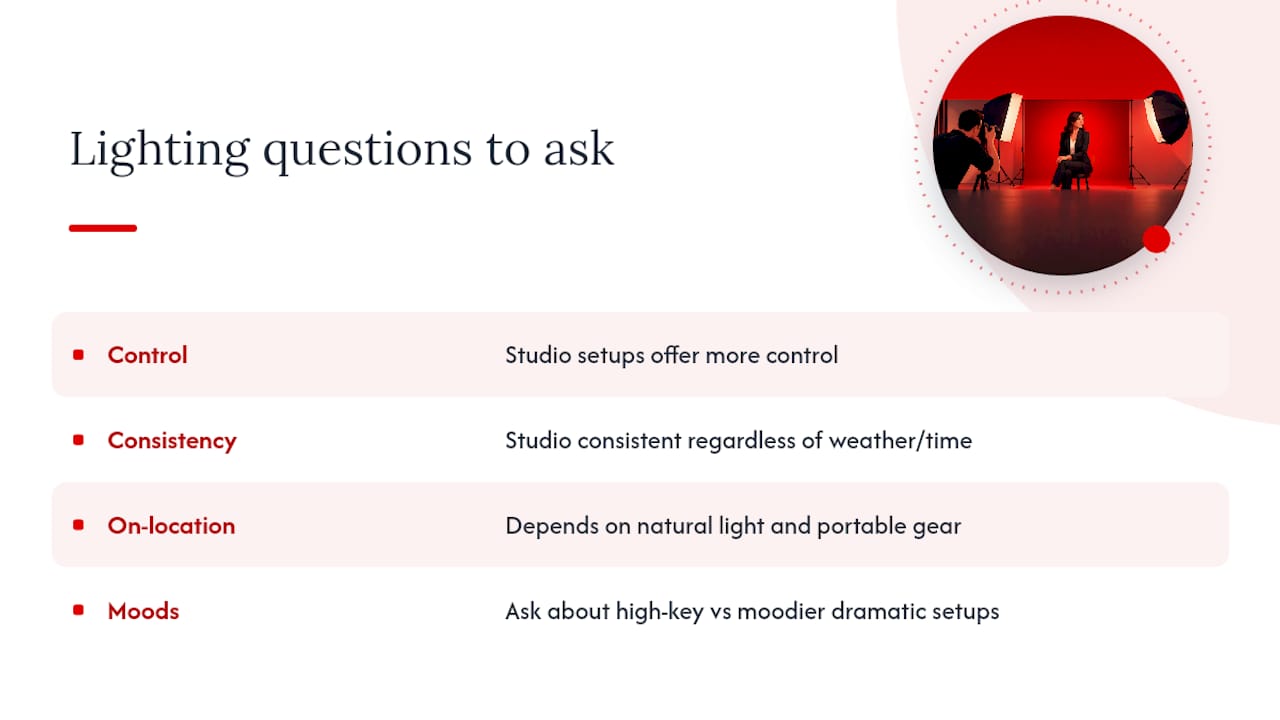
Lighting is the difference between a flat, washed-out headshot and one with depth and dimension. Ask whether the session will use natural light, studio strobes, or continuous lighting, and how that choice fits your intended style.
Studio setups typically offer more control since the environment stays consistent regardless of weather or time of day. On-location sessions depend more on available natural light and portable equipment, so ask how the photographer plans to manage that if you are shooting in an office or outdoor space.
It is also worth asking whether the photographer offers different lighting setups for different moods, a bright, high-key look for approachable industries versus a moodier, more dramatic setup for executive or legal portraits. Knowing the options ahead of time helps you pick a direction that matches your brand rather than settling for whatever setup is fastest to arrange.
11. How do you give feedback during the shoot?
The best time to adjust expression or pose is while the camera is still out, not after you get home and look at proofs. Ask upfront whether the photographer does real-time review on a screen or camera display, since this lets you flag a shot you like or dislike immediately.
Speak up in specific terms. Instead of saying a photo looks “off,” try phrasing like “can we try a softer smile” or “I’d like my shoulders angled slightly more toward the camera.” Specific feedback gets faster adjustments than vague reactions.
If you are unsure whether an expression reads as intended, ask the photographer directly what they are seeing on their screen. They are looking at the same lighting and framing you are, and their read on a shot is often more accurate in the moment than your own sense of how you felt posing.
The one question that tells you everything
I always ask, “Have you had a professional headshot before?” A first timer needs more coaching time built in. Skipping that question once left a client visibly stiff in early shots until we slowed down and adjusted pacing.
— Traci Schowmeyer
How Metroplex Headshots fits into your consultation plan
Once you know your questions, matching them to the right session type is straightforward. Professional headshot services typically include in-studio and on-location sessions, covering styles such as executive, LinkedIn, and business team headshots, so most of the scenarios covered above align with common package offerings.

- Review the Executive Headshot Preparation Checklist before your consultation call.
- Compare session types and pricing on the packages page.
- Schedule a consultation to confirm timing, deliverables, and wardrobe guidance for your specific goals.
If you are weighing the visibility a strong headshot brings to your online profiles, photography-focused SEO guidance explains why platform-specific images matter for getting found in the first place.
Sources
- 10 Questions to Ask a Headshot Photographer | New Orleans
- 17 Questions To Ask a Prospective Headshot Photographer | Backstage
FAQ
What is the 20-60-20 rule in photography?
Definitions vary across photography schools, and no single sourced standard defines this rule for headshots specifically. If your photographer references it, ask them directly how they apply it to posing or lighting in your session.
What looks best in a headshot?
Solid, well-fitted clothing in colors that complement your skin tone tends to photograph more cleanly than busy patterns or logos. A relaxed, natural expression coached by the photographer, rather than a forced smile, generally reads as more approachable and professional.
What to ask ChatGPT for a professional headshot?
ChatGPT and similar tools generate written prep guidance, not photographs, so ask it to help you draft consultation questions, a wardrobe checklist, or talking points for your photographer. It cannot replace an actual photographer’s session or retouching work.
What makes a headshot unprofessional?
Poor lighting, a cluttered or distracting background, and clothing that pulls focus away from your face are common culprits. Retouching that looks unnatural, or a pose and expression that feel stiff rather than confident, also undercut an otherwise solid headshot.

