


Most companies treat headshots as a one-time checkbox. Schedule a photographer, take some photos, post them to the website, and move on. That thinking is exactly why so many organizations end up with a collection of mismatched portraits that quietly undermine their brand every single day. A corporate headshot program explained properly is not a photo shoot. It is a structured, repeatable system for managing how your organization presents itself visually across every platform where clients, recruits, and partners encounter your people. When you build that system intentionally, it becomes one of the most cost-effective branding tools you have.
Table of Contents
- Key takeaways
- Corporate headshot program explained: core components and session logistics
- What retouching standards actually mean for your brand
- Planning and budgeting a corporate headshot program effectively
- The update cycle most companies ignore
- Challenges and best practices for executing the program
- My take on what actually makes these programs work
- Ready to build your program with Metroplex Headshots?
- FAQ
Key takeaways
| Point | Details |
|---|---|
| It is a system, not a shoot | A corporate headshot program covers planning, execution, editing, and regular updates as an ongoing process. |
| Consistency protects brand equity | Matching backdrops, lighting, and editing standards across your team prevent visual drift that erodes professional credibility. |
| Budgets vary by scale | Individual sessions typically run $250 to $600, while team shoots run $150 to $400 per person in major US markets. |
| Update cycles matter | Most programs require a refresh every one to three years to reflect staff changes and brand evolution. |
| Mobile studios reduce friction | Bringing the shoot to your office cuts scheduling disruption and captures more natural, comfortable expressions from employees. |
Corporate headshot program explained: core components and session logistics
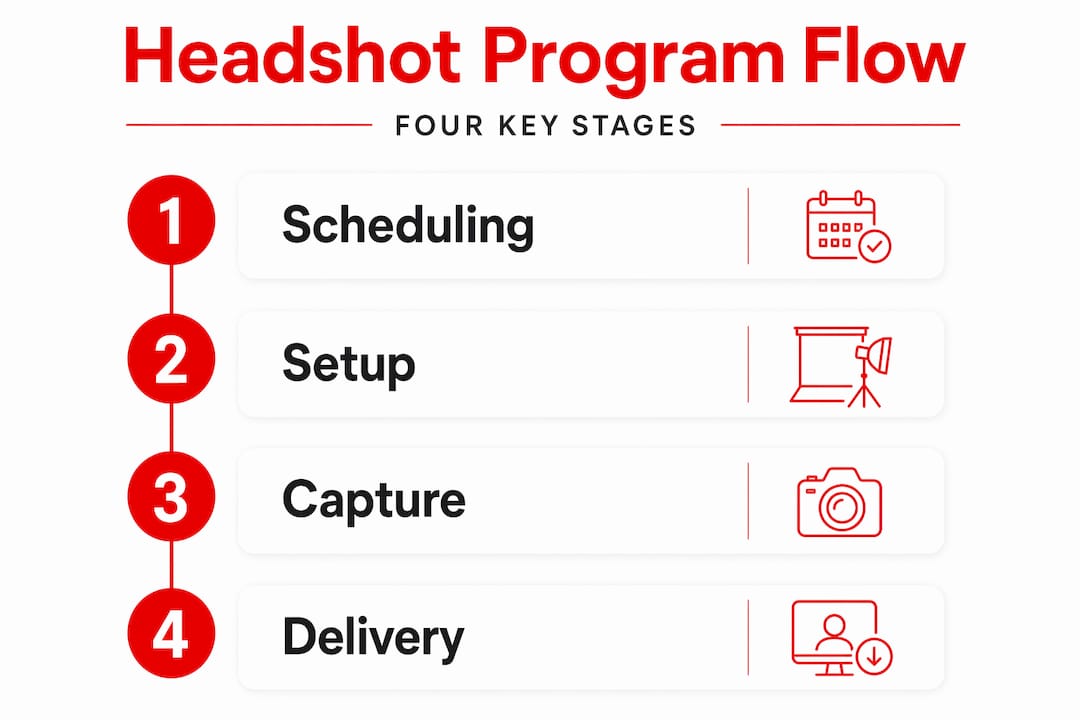
A well-run program has four distinct layers: scheduling, setup, capture, and delivery. Each layer requires decisions that affect the final result, and skipping any one of them creates problems you will spend time correcting later.
Session timing is one of the most underestimated factors. Individual sessions run 20 to 60 minutes, while team shoots for larger groups typically require one to three hours of total session time. For a company with 30 employees, that math matters. Trying to rush 15-minute slots to fit everyone into a single morning guarantees tense expressions and inconsistent results.
When it comes to location, you have two real options.
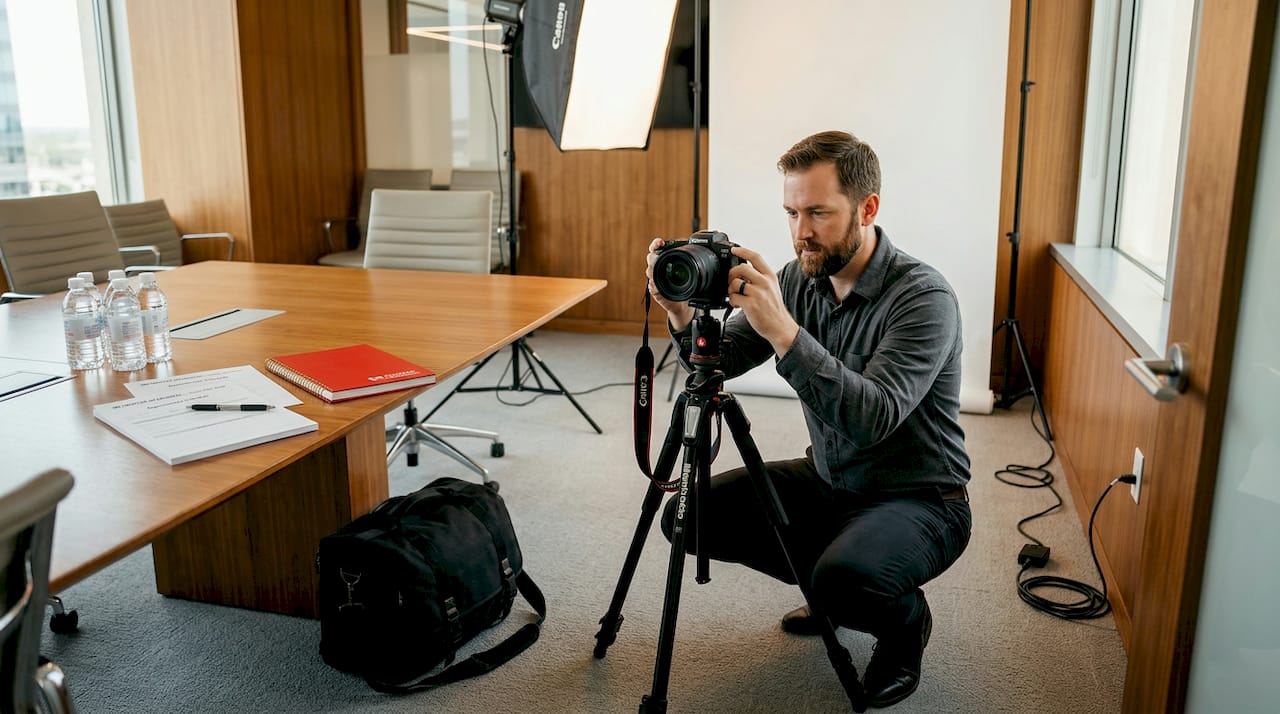
- On-site mobile studio: The photographer brings all equipment to your office, sets up in a conference room or open space, and works through your employee list. Mobile studios allow consistent branding with efficient scheduling, and they minimize the work disruption that comes from pulling employees off-site.
- Traditional studio session: Employees travel to a professional studio space. This option offers more controlled lighting and a wider range of backdrop and setup choices, but it requires more coordination around transportation and scheduling.
Backdrop and lighting choices are not purely aesthetic decisions. They are branding decisions. A backdrop that works for a law firm looks out of place for a tech startup. Corporate portrait lighting standards should produce even, flattering illumination that photographs consistently across different skin tones and does not require heavy post-processing to correct. When lighting is handled correctly at the session level, editing stays clean and efficient.
Pro Tip: When planning a corporate headshot day for a large team, build 10-minute buffer slots every hour. Employees run late, need outfit adjustments, or want a second round of shots. That buffer keeps the entire schedule from collapsing by mid-afternoon.
Employee comfort is the hidden variable in photo session logistics for large corporate teams. People who feel rushed or self-conscious produce stilted photos. A good photographer manages posing, pacing, and conversation to draw out natural confidence. That skill is just as important as technical lighting ability.
What retouching standards actually mean for your brand
The phrase “photo editing” means different things to different people. In a corporate context, it has a specific and intentional scope. Understanding that scope helps you set expectations with your photographer and with your employees.
Standard retouching removes temporary blemishes like a breakout or a minor skin irritation on the day of the shoot. It does not alter permanent features. Scars, moles, wrinkles, and natural facial structure stay intact. This is not just an ethical standard. It is a practical one. When a client meets your executive in person after seeing a heavily retouched headshot, the mismatch reads as dishonest.
Beyond blemish removal, editing standards for a program cover three key areas:
- Color correction: All images should be adjusted to the same white balance and tonal range so that portraits from different sessions still look like they belong to the same organization.
- Background consistency: If your program uses a specific backdrop color or a blurred office environment, every image should match that standard regardless of when or where it was shot.
- Exposure and contrast: Faces should be lit to the same brightness level across the team. A significantly darker portrait next to a brighter one signals that the images were not produced under a single program.
Editing consistency across employee photos is what separates a polished “team” page from a collection of individual photos that happen to share the same URL. The difference is visible in about two seconds to anyone who visits your website.
Pro Tip: Ask your photographer to provide a sample edit on one image before they process the entire batch. This is your chance to align on retouching philosophy before corrections become expensive.
Planning and budgeting a corporate headshot program effectively
Budget is where most programs either succeed or get abandoned halfway through. The numbers are predictable if you plan honestly for what the program actually requires.
| Budget Factor | Individual Session | Team Session |
|---|---|---|
| Typical price range | $250 to $600 per person | $150 to $400 per person |
| Session length | 20 to 60 minutes | 1 to 3 hours total |
| Retouching included | Usually 1 to 3 final images | Varies by package |
| Travel or studio fee | May apply | May be absorbed into per-person rate |
| Mobile studio setup | Add-on cost | Often included in team pricing |
The per-person rate for team shoots is lower precisely because setup time and photographer travel are distributed across a larger group. If your team has more than eight people, a coordinated team session almost always delivers better value than booking individual appointments separately.
Budget considerations must include session length, retouching scope, photographer experience, and whether you need a mobile setup or studio space. Geographic location also moves the numbers. Markets like New York, Los Angeles, and Dallas carry higher photographer rates than mid-sized cities, though the quality ceiling is also higher.
Connecting your budget to a pricing guide for headshots before you get quotes helps you recognize what is reasonable and what represents a genuine premium. That context prevents both overspending and the temptation to cut corners on something your clients will see every day.
Pro Tip: When calculating your headshot budget, add 15 to 20 percent for future update sessions. New hires, promotions, and brand refreshes will require additional photos within the first year. Planning for that upfront avoids scrambling later.
The update cycle most companies ignore
A headshot from five years ago is not neutral. It is actively working against you. Regular headshot updates keep visual assets relevant, reflecting how your people look today and signaling that your organization pays attention to its own presentation.
The standard update cycle runs every one to three years, adjusted by these four factors:
- Staff turnover rate: Organizations with high turnover need more frequent updates simply to keep their team page accurate. A recruiter or client who sees a photo of someone who left 18 months ago does not build trust.
- Brand refresh: Any time your company updates its visual identity, including logo colors, website design, or photography style, headshots taken under the old standards become inconsistent.
- Significant appearance changes: Employees who change their hair significantly, gain or lose weight, or simply look noticeably different than their current photo should be refreshed outside the normal cycle.
- Platform expansion: If your company begins using headshots in new contexts, such as speaking engagements, media coverage, or proposals, the quality bar for those images is higher than a standard website thumbnail.
Managing update logistics within a larger program is easier when you treat it as an annual line item rather than a reactive expense. Updated headshots support online presence and client engagement across every platform where your people appear, from LinkedIn to RFP documents to internal directories.
Challenges and best practices for executing the program
Even well-funded programs run into execution problems. The most common ones are entirely avoidable.
Scheduling conflicts are the most frequent issue in photo session logistics for large corporate teams. Employees are protective of their calendars, and a headshot session feels optional until someone explains why it is not. Clear communication from leadership, not just HR, signals that participation is a professional priority.
Inconsistent branding is the second pitfall. It usually happens when departments book headshots separately over time without a shared brief for the photographer. The result is visual drift across employee photos, where the sales team looks like they work at a completely different company than the executives.
Here are the best practices that make the biggest difference:
- Create a single program brief that documents your backdrop standard, lighting approach, image dimensions, and editing guidelines. Every photographer you work with gets this document.
- Assign a single internal coordinator for each session who handles scheduling, employee reminders, and on-site logistics. Decentralized coordination is where headshot days fall apart.
- Choose a photographer experienced with corporate clients. Working with large groups under time pressure requires a different skill set than portrait or event photography.
- Communicate wardrobe guidance in advance. Solid colors, nothing too busy, and one level above daily attire produces the most consistent and professional results across a diverse team.
Pro Tip: Send employees a brief preparation guide two days before the session. Include what to wear, where to go, how long it will take, and what the photos will be used for. Informed employees arrive calmer and photograph better.
Employee photos appear across websites, LinkedIn, internal directories, and marketing materials. When those images are consistent and polished, they reinforce that your organization is organized and professional. That impression is formed before a single word is read.
My take on what actually makes these programs work
I’m Traci Schowmeyer, and after working with dozens of corporate clients, here is what I’ve learned that most program guides leave out.
The photos are not the hard part. The logistics and the buy-in are.
I’ve seen beautifully planned sessions fall apart because one senior leader skipped their appointment and three others followed suit. I’ve also seen tight-budget programs produce exceptional results because the coordinator communicated clearly, employees trusted the process, and the photographer had genuine experience working with people who do not consider themselves photogenic.
What I’ve found is that employee comfort is the single most underrated variable in image quality. When people feel at ease, that confidence shows in the photo. No amount of retouching replaces a natural, genuine expression. The best thing a company can do is hire a photographer who is also a skilled communicator, not just a skilled technician.
My pragmatic view on balancing quality and cost: do not cut the retouching budget. That is where brand consistency lives. You can reduce the number of final images per person or book a mobile studio instead of a premium studio space. But inconsistent or low-effort editing is what makes a team page look like a lineup instead of a brand.
Mobile studios are not a compromise. In many cases, they are the better choice. People photograph more naturally in their own environment, and the reduction in scheduling friction means you actually get everyone captured in a single coordinated push.
— Traci Schowmeyer
Ready to build your program with Metroplex Headshots?
Understanding what a corporate headshot program requires is step one. Executing it with the right partner is what turns that understanding into a real brand asset.
At Metroplex Headshots, we work with businesses of all sizes to design and deliver headshot programs that reflect who you are and how you want to be perceived. From mobile studio sessions that come to your office to coordinated team days with full editing and delivery, every detail is built around your brand standards. Explore our corporate headshot packages to see the options designed for teams and organizations. If you are planning a full company-wide rollout, our company-wide headshot guide walks through exactly how to organize the process from first call to final delivery. Let’s make your team look like the organization you are.
FAQ
What is a corporate headshot program?
A corporate headshot program is a structured system for planning, executing, editing, and updating professional portraits across an organization. It goes beyond a single photo session to maintain brand consistency over time.
How much does a corporate headshot program cost?
Individual sessions typically run $250 to $600, while team shoots range from $150 to $400 per person depending on location, session length, and retouching scope.
How often should corporate headshots be updated?
Most programs require updates every one to three years. More frequent updates are needed when staff turnover is high, the brand refreshes its visual identity, or employees’ appearances change significantly.
What retouching is standard for corporate headshots?
Standard retouching removes temporary blemishes while leaving permanent features intact. Color correction and exposure consistency across the batch are also part of professional editing standards.
Should companies use a mobile studio or a traditional studio?
Mobile studios are practical for teams of eight or more, reducing scheduling disruption and capturing employees in a familiar environment. Traditional studios offer more controlled setups and are well-suited for executive-level portraits where a premium backdrop is part of the brand standard.

