


The strongest medical headshot is a real, professionally captured photograph, not a synthetic image, framed against a neutral background that reads as both competent and warm. It belongs in three places above all: your provider directory, your telehealth login screen, and, for residents, your ERAS application. Studio sessions and live virtual capture are the two most reliable ways to get there.
TL;DR:
- Consistent background, conservative retouching, and a professional attire matching each role are crucial for building patient trust through headshots.
- Using a white coat for physicians or scrubs for nurses, and avoiding props like clipboards, ensures headshots accurately reflect daily professional roles.
- Proper posing, with relaxed arms, direct eye contact, and a slight smile, significantly enhances perceptions of warmth and competence within milliseconds.
- Digital file standards vary by platform, with most requiring neutral backgrounds, specific crops, and JPEG formats to maintain directory uniformity.
- Virtual or on-site studio sessions generally offer the best balance of quality, convenience, and consistency for large groups or busy practices.
Table of Contents
- What Should Professional Medical Headshots Look Like by Role?
- What to Wear and How to Use Medical Props Correctly
- How Do You Pose for a Medical Headshot That Feels Both Competent and Approachable?
- What Background and Technical Specs Do Medical Headshots Need?
- How Do You Get Medical Headshots: Studio, On-Site, Virtual, or AI?
- How Do Health Systems Scale Consistent Medical Headshots?
- What Should You Do 24 to 48 Hours Before a Medical Headshot Session?
- How Metroplex Headshots’ Process Reflects Research on Trust and First Impressions
- What Legal and Privacy Rules Apply to Medical Headshots?
- How Much Retouching Is Appropriate for Medical Headshots?
- Why Getting This Right Matters More Than Most Administrators Assume
- Ready to Update Your Provider Photos?
- Sources
What Should Professional Medical Headshots Look Like by Role?
A physician, a bedside nurse, and a hospital administrator are all selling the same thing in their headshot: trust. But the visual language that earns it differs by role, and treating every staff photo the same way is one of the most common mistakes health systems make.
Physicians generally benefit from a white coat or tailored business attire, direct eye contact, and a composed half smile. Research on how patients evaluate providers found that formal attire against a neutral background swayed patient choice more strongly than casual looks, particularly for higher-severity conditions, which is exactly the scenario where a first impression carries the most weight. A cardiologist’s directory photo is doing different work than a dermatologist’s, but both hold up better in a formal register.
Nurses tend to photograph best in clean scrubs or a branded polo, often without a white coat, since the coat can read as ill-fitting or borrowed when nursing culture skews toward scrubs as the professional uniform. A relaxed, genuine smile serves nurse headshots particularly well. Patients already associate nursing with approachability, and the photo should confirm that instinct rather than fight it.
Residents preparing ERAS applications face the strictest rules of any group. The AAMC’s own guidance calls for a neutral background, business attire, and a precise head-and-shoulders crop, and deviating from that spec is a common reason applications get flagged for a re-upload.
Administrative and support staff (practice managers, care coordinators, front-desk leads) usually look right in business casual with a warm, open expression. They are rarely photographed in white coats, since the coat can misrepresent their clinical role.
A few framing details matter across every role:
- Crop tight enough that the face fills most of the frame. At thumbnail size, anything else reads as a blur.
- Keep eye contact direct and level with the lens. Looking slightly off-camera reads as evasive in a directory photo.
- Skip statement glasses with heavy tint or glare. If glasses are part of your everyday look, keep them, but the frame shouldn’t compete with the face.
- Match the expression to the setting. A pediatric specialist can smile more broadly than a surgeon, and neither look is wrong.
What to Wear and How to Use Medical Props Correctly
Attire and props are where most self-guided headshots go wrong. The fix comes down to a short set of rules rather than trial and error.
- Wear the white coat if you’re a physician or advanced practice provider, and let it stay buttoned or open depending on your specialty’s norm. Surgeons and hospitalists often photograph in a fully buttoned coat; outpatient specialists sometimes look more approachable with it open over business attire.
- Skip the coat entirely for ERAS submissions unless your program specifically requests it. AAMC’s guidance prioritizes business attire and a neutral background over clinical props for residency applications.
- Choose solid colors over busy patterns for scrubs and shirts. Small prints and tight stripes create a moiré effect at thumbnail size and look distracting on a directory grid.
- Keep jewelry minimal. A watch or simple earrings read fine; anything that catches light or dangles will pull the eye away from your face in a 200-pixel-wide crop.
- Use a stethoscope only if it’s part of your daily routine, and drape it naturally around the neck rather than holding it up to the camera. Research on medical imagery found that including a stethoscope, or two or three medical icons, in a photo increased how trustworthy viewers rated the provider, but the effect depended on the prop looking incidental rather than staged.
- Avoid holding a clipboard, tablet, or folder as a posing crutch. These props rarely add credibility and often just give your hands something to fidget with.
The through-line: props and attire should signal what you actually do every day, not what you think a “doctor photo” is supposed to include.
How Do You Pose for a Medical Headshot That Feels Both Competent and Approachable?
Small physical adjustments matter more than most clinicians expect. Viewers form judgments about a provider’s trustworthiness within a few hundred milliseconds of seeing their photo, according to psychological research on snap judgments, and that first read comes almost entirely from posture and expression rather than from wardrobe.
A few adjustments consistently improve how a headshot reads:
- Drop your chin very slightly and lengthen your neck. This avoids the “looking down the nose” effect that reads as distant.
- Square your shoulders to the camera at a slight angle rather than straight on. A dead-center pose can look stiff in a directory grid.
- Relax your arms at your sides or loosely crossed in front; crossed arms held tight against the chest read as guarded.
- Aim for what photographers call the “slight smile”: lips closed or barely parted, eyes engaged, no forced grin. It photographs as warm without undercutting authority.
Pro Tip: Practice your expression in a mirror for 30 seconds before the shoot. Most people default to either a flat, closed-off stare or an exaggerated grin. The natural middle ground takes a few tries to find, and locating it before the camera is on you saves the whole session.
The most common mistakes are easy to fix once you know to look for them: over-smiling until the eyes squint shut, arms crossed defensively, or a background so busy it competes with the face. If your session includes a monitor or tablet nearby, glance at a sample shot after the first few frames and adjust before the photographer moves on.
What Background and Technical Specs Do Medical Headshots Need?
Consistency matters more in medical headshots than in almost any other professional photo category, because these images live side by side on directory pages and org charts where mismatched backgrounds instantly look unprofessional.
A neutral gray or soft blue background remains the safest default for provider directories and telehealth platforms. It photographs well against most skin tones, doesn’t compete with a white coat, and matches what most EHR and telehealth vendors expect. Lighting should be soft and even, ideally from two sources at roughly 45 degree angles to the face, since a single hard light source creates shadows under the eyes and nose that can look unflattering, or even unwell, at high resolution.
For file specs, follow the platform’s own requirements rather than a generic headshot standard:
- ERAS applications: a neutral background, business attire, and a head-and-shoulders crop, per AAMC’s published ERAS photo guidance.
- Provider directories and EHR profiles: typically a square or near-square crop, JPEG format, sized for both a large profile view and a small thumbnail without losing facial clarity.
- Telehealth platforms: similar square crop requirements, but test how the image renders at the small size shown during a video call login screen.
The stakes here are real. Healthgrades found that 52% of patients would choose a provider with a professional photo and a 4-star rating over one with no photo and a 5-star rating. For parents choosing a pediatrician, this preference increases for parents choosing pediatricians. A background that reads as consistent and professional is doing real work toward that decision, not just aesthetic polish.
How Do You Get Medical Headshots: Studio, On-Site, Virtual, or AI?
Every capture method trades off quality, convenience, and cost differently, and the right choice depends on whether you’re photographing one physician or four hundred.
- Studio sessions deliver the most consistent lighting and the highest retouching quality, varying from moderate to higher cost levels per person depending on the market and package, though pricing varies with session length and delivery speed. Turnaround is usually a few days to a week.
- On-site or mobile studio sessions bring the photographer to your clinic or hospital, which cuts staff travel time to zero and works well for departments that can’t all leave the floor. Volume pricing generally applies for groups, and a well-run on-site day can capture dozens of providers in a single afternoon.
- Live virtual capture, where a professional photographer directs the shoot remotely while you use your phone’s rear camera, produces near-studio results with minimal disruption to a packed clinical schedule. This tends to be the most practical option for a solo physician or small practice that can’t justify a half-day studio slot.
- Self-guided smartphone photos are the lowest-cost option but the least consistent. Without professional lighting direction, results vary widely, and inconsistency across a directory undercuts the polish that formal photography research links to patient trust.
- AI-generated headshots should be avoided for patient-facing profiles. Many health systems now explicitly prohibit synthetic images in provider directories over recognition and trust concerns; a patient who meets a provider in person expecting the face from an AI-smoothed photo experiences a mismatch that erodes rather than builds trust.
For most solo practitioners and small practices, live virtual capture hits the best balance of quality and convenience. For larger groups, an on-site day with a mobile studio setup usually beats sending everyone to book individual studio slots.
How Do Health Systems Scale Consistent Medical Headshots?
Rolling out headshots across a multi-site medical group is a logistics problem before it’s a photography problem. Get the standard locked down before you schedule a single session.
- Decide your visual standard first. Pick one background color, one retouching policy (natural, minimal edits only), and one file format spec, then document it so every location follows the same rules. Health systems that skip this step end up with a directory where half the providers look photographed in 2019 and half look photographed last month.
- Collect image releases and consent forms up front. Providers need to sign off on how their photo will be used (directory, marketing, telehealth) before the shoot day, not after.
- Build a scheduling model that fits clinical hours. Fifteen-minute capture windows during lunch blocks or between patient hours, staggered across a week, usually work better than trying to pull an entire department off the floor at once.
- Add a quality-control checkpoint before final delivery. Someone should review every image against the standard (background match, crop, expression) before it goes live, catching outliers while a reshoot is still easy to schedule.
- Negotiate volume pricing and watch for vendor red flags. A vendor unwilling to commit to a fixed per-person rate for groups over a certain size, or one that can’t guarantee background and lighting consistency across multiple sessions, is a sign to keep looking.
Virtual capture sessions can meaningfully cut costs for distributed systems with providers across many clinic locations, since it removes travel time and mobile studio setup entirely from the equation.
What Should You Do 24 to 48 Hours Before a Medical Headshot Session?
A short prep window prevents most of the re-shoot requests that eat up a studio’s calendar.
- Press or steam your coat and primary outfit the night before, and pick one backup outfit in case of a last-minute spill or stain.
- Get a haircut or trim at least three to four days ahead, never the day before. Fresh cuts can look slightly unnatural on camera.
- Bring your stethoscope or any daily-use accessory, but leave clipboards, tablets, and folders at your desk.
- For virtual sessions, test your phone’s rear camera and set up a stable mount rather than hand-holding the device; even a slight wobble shows up in guided remote sessions.
- Find a quiet room with even light for a virtual session, ideally facing a window rather than backlit by one.
- Skip heavy foundation or dramatic makeup changes. A light, natural application photographs best; anything too matte or too shimmery reads oddly under studio lighting.
Pro Tip: Hydrate well the day before your session. Dehydration shows up as under-eye shadowing and dull skin tone on camera faster than almost any other factor, and it’s the easiest one to control.
Ask your photographer upfront how final files will be delivered (resolution, format, and whether you’ll get both a square crop and a full-frame version) so you’re not chasing down the right file weeks later.
How Metroplex Headshots’ Process Reflects Research on Trust and First Impressions
Traci Schowmeyer built Metroplex Headshots around a simple observation: a headshot is often the first data point a patient has about a provider, long before an appointment happens. The studio’s session structure, in-studio, on-location, mobile studio for clinics, and live virtual capture, exists to give every role, from a solo physician to a hundred-provider health system, a path to a consistent, professionally lit photo without disrupting a clinical schedule.
The research is consistent on one point: patients read competence and warmth from a face within milliseconds, and that read shapes their expectations before a single word is exchanged. A headshot workflow built around formal attire, neutral backgrounds, and natural expression isn’t cosmetic polish. It’s addressing the exact variables the research says patients respond to.
Retouching at Metroplex Headshots stays deliberately conservative, correcting lighting and color rather than reshaping a provider’s face, which keeps the final image recognizable at the bedside. Background editing keeps a health system’s directory visually uniform even when sessions happen across different clinic locations on different days.
What Legal and Privacy Rules Apply to Medical Headshots?
Medical headshots carry a specific set of privacy considerations that generic corporate photography doesn’t, mostly around consent, image ownership, and how a photo intersects with a provider’s clinical identity.
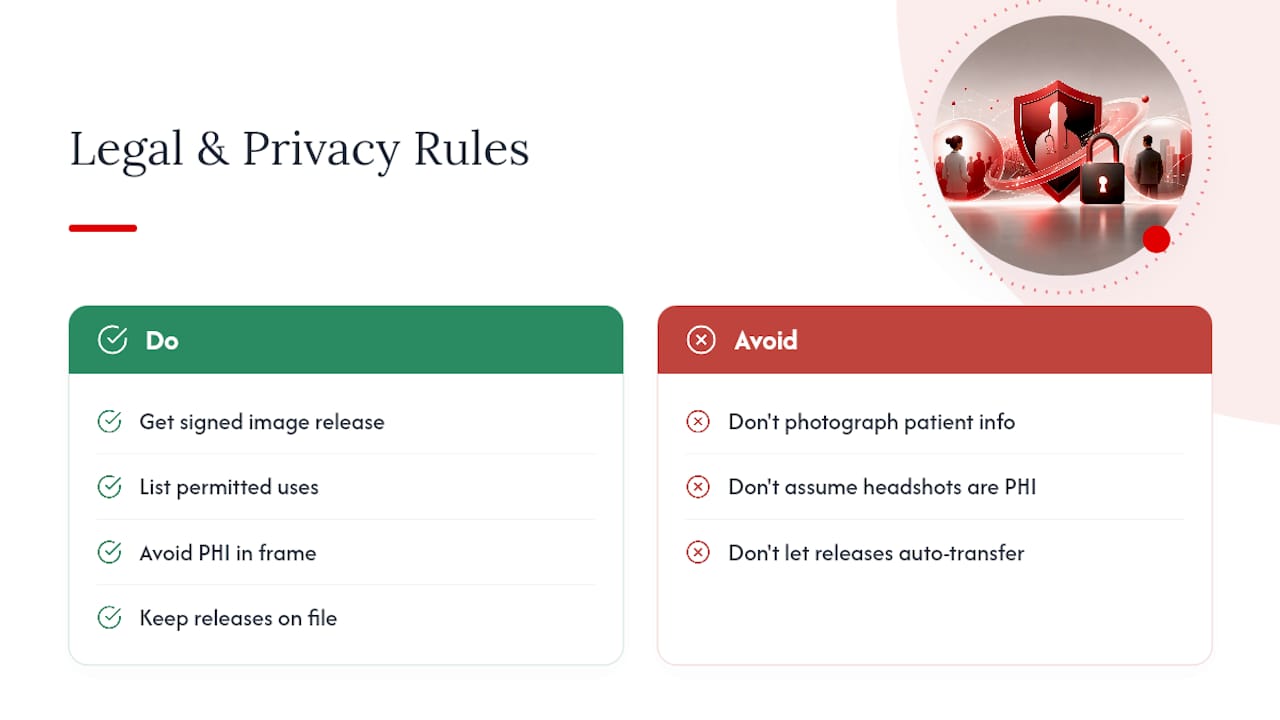
Get a signed image release from every provider before a session, specifying exactly where the photo can appear: your website, provider directory, marketing materials, or a third-party credentialing platform. Providers often don’t realize a headshot taken for an internal directory can end up licensed to an insurance network’s site unless the release explicitly limits its use.
HIPAA itself governs protected patient health information, not a provider’s own headshot, so a clinician’s photo isn’t PHI in the way a patient’s chart is. Where privacy risk actually shows up is in the shoot logistics: sessions held in clinical areas need to avoid capturing patient charts, whiteboards with patient names, or identifiable patients in the background, even accidentally, during setup or between shots. A mobile studio session in a hallway or exam room should be scheduled during a lull, and the photographer should scan the frame for any visible patient information before shooting.
Keep signed releases and any model consent documentation on file for the life of the image’s use, and revisit them if a provider leaves the practice, since most releases don’t automatically transfer to a new employer or a stock photo license.
How Much Retouching Is Appropriate for Medical Headshots?
Retouching a medical headshot should correct technical flaws, not alter identity. The goal is a photo that looks like the provider on their best day, not a different person entirely.
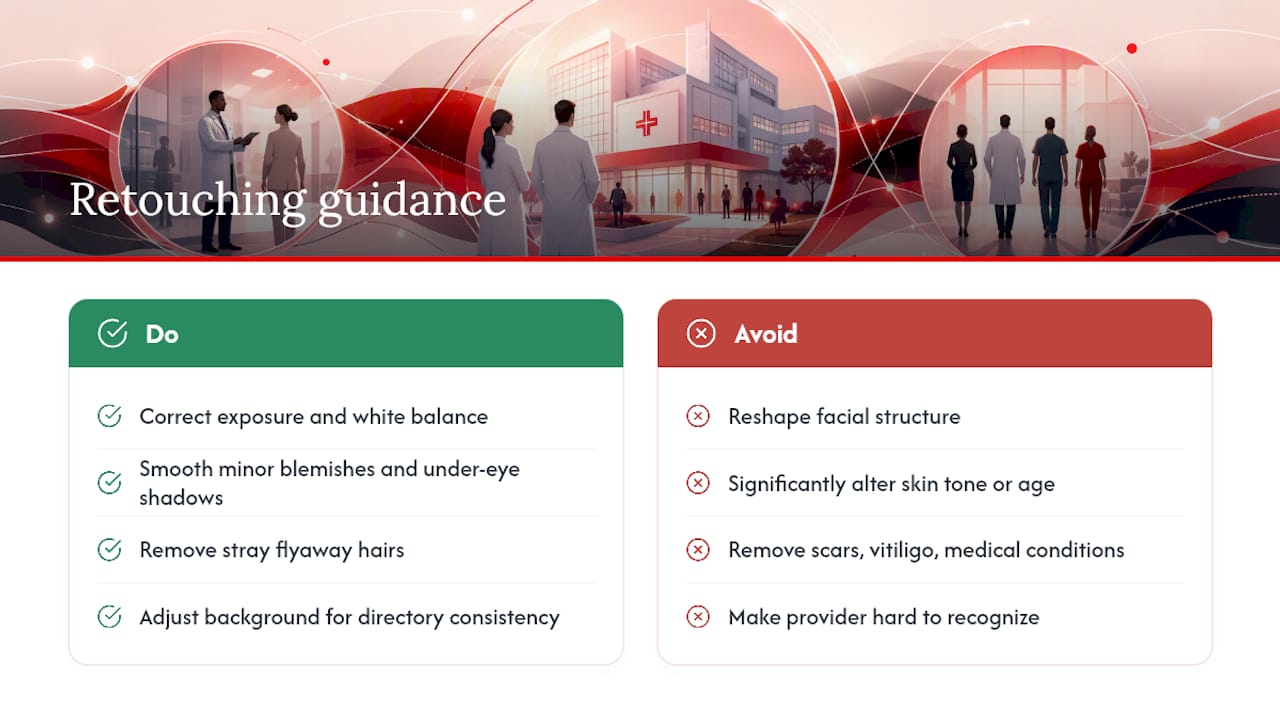
Appropriate edits include correcting exposure and white balance, smoothing out minor skin blemishes or under-eye shadows caused by studio lighting, removing stray flyaway hairs, and adjusting background color for consistency across a directory. These are corrections a good photographer would otherwise get right in-camera and are standard practice in professional portraiture.
Edits to avoid: reshaping facial structure, significantly altering skin tone or age appearance, or removing permanent features like scars, vitiligo, or visible medical conditions a provider hasn’t asked to have removed. A patient who meets their provider in person and notices a mismatch with the directory photo loses some of the trust the photo was supposed to build in the first place, which defeats the entire purpose of investing in professional imagery.
A useful rule for any studio or in-house photo team: if an edit would make the provider hard to recognize walking into an exam room, it’s too much. Set that as a written retouching policy before a system-wide rollout begins, so every provider gets the same conservative treatment regardless of who edits their file.
Why Getting This Right Matters More Than Most Administrators Assume
The conventional advice on medical headshots treats them as a box to check: get everyone a decent photo, post it, move on. That undersells what the research actually shows. Patients form a trust judgment from a face in milliseconds, and that judgment shapes how they interpret everything that follows, including a provider’s competence and even their expected treatment outcomes.
Where most health systems get it wrong is inconsistency, not bad photography. A directory with five different backgrounds, three different retouching styles, and photos taken across six years looks worse than one with modest but uniform images. Consistency is the actual signal of a well-run organization, more than any single photo’s technical polish.
If you’re prioritizing one thing first, prioritize the standard, not the vendor. Decide on your background, your retouching policy, and your crop specs before you book a single session. Everything else, studio versus virtual, in-house versus outsourced, becomes an easier decision once that standard exists.
— Traci Schowmeyer
Ready to Update Your Provider Photos?
Professional headshot services can give medical practices a faster path to consistent, patient-ready photography than piecing together individual studio visits or hoping self-guided phone photos hold up across a directory. Services include in-studio sessions, on-location and mobile studio setups for busy clinics, and live virtual capture for physicians who can’t step away from a packed schedule, backed by conservative retouching and background editing built for directory-wide consistency.

For a solo practice, a headshot session built around your specialty gets you a directory-ready photo without guessing at attire or lighting on your own. For medical groups and health systems coordinating dozens or hundreds of providers, the national and enterprise headshot programs handle scheduling, volume pricing, and cross-location consistency as one project instead of dozens of separate bookings. Reach out to Metroplex Headshots to request a sample gallery or a team quote for your next credentialing cycle.
This article is general information, not a substitute for advice from a qualified doctor. Consult a qualified healthcare professional about your own circumstances before acting on anything here.

