


Why Executive Portrait Photography Is a Career Asset, Not a Luxury
Executive portrait photography is the practice of creating high-quality, professionally directed images that communicate leadership, authority, and personal brand — going well beyond a simple headshot.
Here’s what you need to know at a glance:
- What it is: A professionally lit, carefully directed portrait session designed for C-suite leaders, executives, and senior professionals
- Who it’s for: CEOs, CFOs, VPs, board members, and any professional whose image represents a company or personal brand
- Where images are used: LinkedIn profiles, company websites, press releases, speaking engagements, and media appearances
- Key difference from a headshot: Executive portraits capture personality, environment, and authority — not just a face on a plain background
- When to update: Every 2-3 years, or after a promotion, rebrand, or significant change in appearance
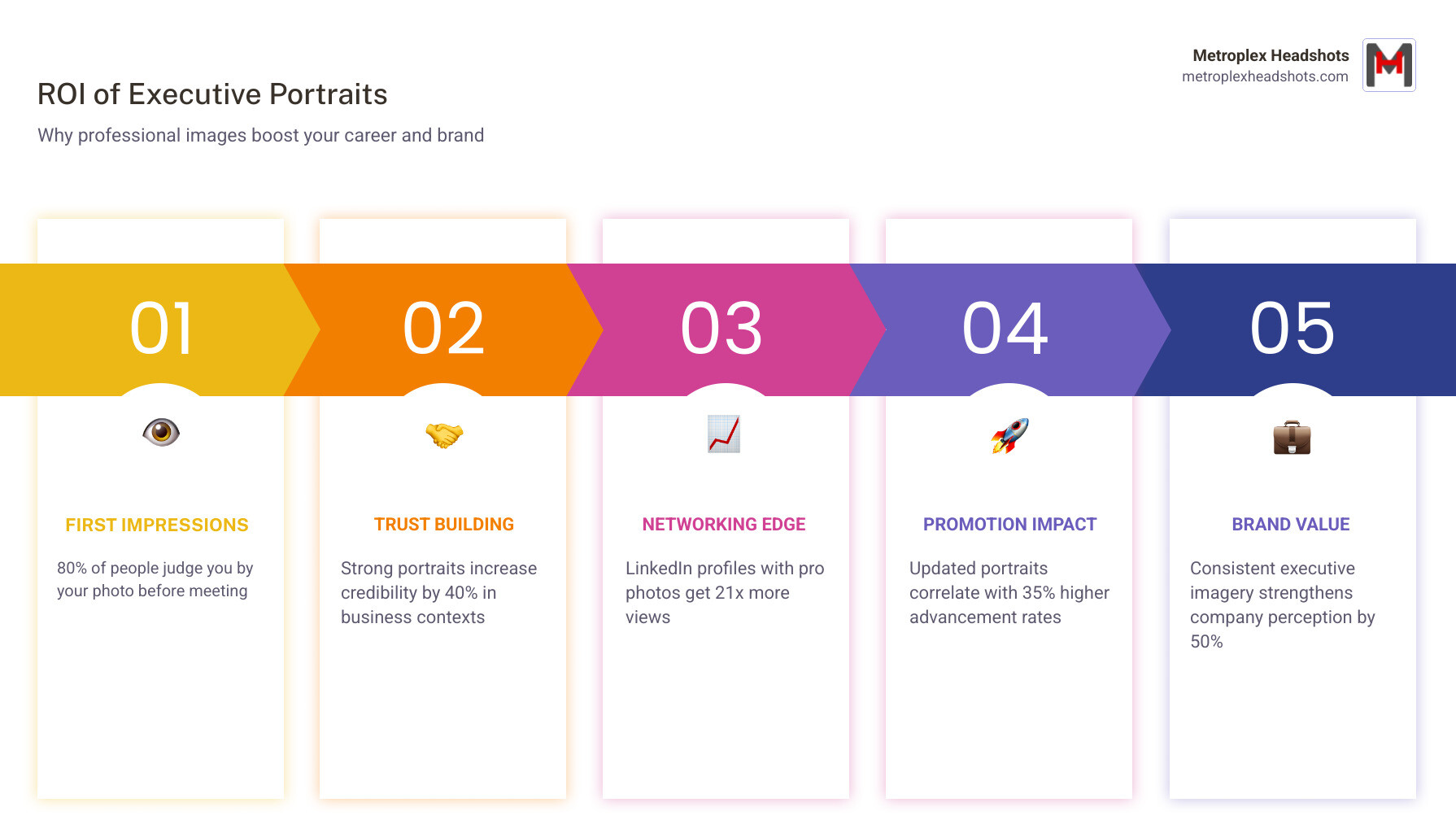
Your portrait is often the first thing a potential client, investor, or partner sees before they ever meet you. A weak image sends the wrong message — and in competitive industries, that matters.
Think of it this way: if your photo looks like it was taken at a company picnic five years ago, it quietly undermines every professional impression you’re trying to make. A strong executive portrait, on the other hand, does the opposite — it builds trust before you say a word.
I’m Traci Schowmeyer, owner of Metroplex Headshots and a commercial photographer with over 25 years of experience specializing in executive portrait photography for professionals ranging from new hires to C-suite teams at Fortune 100 companies. In this guide, I’ll walk you through everything — from lighting and posing to wardrobe, workflow, and licensing — so you know exactly what to expect and how to get the most from your session.
Defining Executive Portrait Photography vs. Standard Headshots
When you hear the term “headshot,” you probably think of a standard, tightly cropped photo of a person from the shoulders up, usually against a solid gray or white background. While these are essential for internal directories or basic ID badges, they often lack the depth required for high-level leadership.
In our guide Beyond the Suit: How Headshots Differ for Corporate Executives and Business Professionals, we explore how the “devolved” nature of modern photography—thanks to smartphones—has made the distinction even more important. Executive portrait photography is a philosophical shift. It provides an opportunity for creativity that a standard headshot simply doesn’t allow.
An executive portrait often incorporates the subject’s work environment, using creative lighting and stylized posing to tell a story. It’s the difference between saying “This is what I look like” and “This is who I am as a leader.”
| Feature | Standard Business Headshot | Executive Portrait |
|---|---|---|
| Framing | Tight crop (head and shoulders) | Wider crop (waist-up or full body) |
| Background | Solid studio color or simple blur | Environmental (office, boardroom, city) |
| Lighting | Flat, even, and predictable | Dramatic, directional, or cinematic |
| Purpose | Identification and consistency | Personal branding and authority |
| Time | 10–15 minutes | 45 minutes to 2 hours |
Whether we are shooting in our studio or at your headquarters in Dallas or Fort Worth, we focus on capturing that “spark of energy” in the eyes. This is what attracts viewers who don’t know you yet and makes them think, “I would work with this person.”
Choosing the Right Style for Your Brand
Your portrait needs to align with your personal and corporate brand identity. We collaborate often with Coin Branding, a brand strategy firm in Toronto led by Andris Pone, to understand how a visual narrative supports a professional journey.
Are you a tech innovator in Frisco who needs a high-energy, lifestyle-driven look? Or are you a partner at a law firm in downtown Dallas who requires a more traditional, authoritative environmental portrait? Understanding the “why” behind the shoot is the first step in Your Professional Edge: A Comprehensive Guide to Business Portrait Photography.
Mastering the Technicals: Lighting and Gear for Executive Portrait Photography
Lighting is the single most important technical element in executive portrait photography. It’s how we sculpt the face, hide imperfections, and create a mood of authority.
Standard setups we use include:
- Three-Point Lighting: The foundation of studio work, consisting of a key light (main source), a fill light (to soften shadows), and a rim light (to separate the subject from the background).
- Rembrandt Lighting: Characterized by a small triangle of light on the cheek opposite the key light. It’s a classic, moody look that conveys depth and wisdom.
- Clamshell/Butterfly Lighting: Often used for a more “approachable” or “glamour” corporate look, placing the lights above and below the face to minimize skin texture and create beautiful catchlights in the eyes.
Choosing the right environment is just as vital as the lights themselves. We cover this extensively in our article on Lights, Camera, Business: Choosing the Right Corporate Photo Studio.
Essential Equipment for On-Location Executive Portrait Photography
Many of our clients in Plano and McKinney prefer that we come to them. To maintain studio quality in a corporate boardroom, we use a specialized portable kit. This usually includes the Manfrotto 5001B Light Stand because it is compact and sturdy, paired with a Westcott 28×28″ Apollo Softbox. Softboxes are generally superior to umbrellas in an office because they prevent light from spilling onto glass partitions or whiteboards.
Other essential gear for a DFW on-location shoot includes:
- The 85mm Lens: Often called the “king of portrait lenses,” it provides beautiful compression that flatters facial features without distortion.
- Savage “Port-a-stand” support system: A flexible, portable background system that allows us to set up a professional studio in any 12×15 ft office space.
- PocketWizard Plus III Transceivers: For reliable, wireless flash triggering.
- Tethered Shooting: We connect our camera to a laptop so you can see the results in real-time. This allows for immediate adjustments to your tie, hair, or expression, ensuring you leave the session 100% satisfied.
Directing for Authority: Posing and Expression Techniques
Most executives aren’t professional models. In fact, many are quite nervous about being in front of the lens. Our job is to be your coach. We use specific techniques from our guide Commanding the Frame: Your Guide to Executive Headshots to help you project confidence.
One of our favorite tricks is the “Turtle Trick.”
By having the subject push their forehead slightly toward the camera and down, we eliminate the appearance of a double chin and create a sharp, defined jawline. It feels awkward to do, but it looks incredible on camera.
We also focus on:
- Body Language: Squaring the shoulders slightly for authority, or angling them for a more approachable, modern feel.
- The Eyes: We might ask you to “squinch” (a slight tightening of the lower eyelids) to convey focus and confidence rather than looking like a “deer in the headlights.”
- Handling Challenges: For subjects with glasses, we tilt the frames or raise the light sources to eliminate glare. For nervous subjects, we start with casual conversation to build rapport before the first shutter click.
For more deep-dives into these techniques, check out The Ultimate Guide to Achieving Your Best Business Headshot.
Preparation: Wardrobe, Grooming, and Consultation
Preparation is 90% of a successful shoot. During our initial consultation, we discuss everything from your target audience to your color palette.
- Wardrobe: Stick to solid, neutral colors (navy, charcoal, forest green). Avoid busy patterns or logos that distract from your face. Layers like blazers and vests add depth and visual interest.
- Grooming: Men should be clean-shaven or have neatly trimmed facial hair. We recommend professional hair and makeup for everyone—it’s not about “looking made up,” but about controlling shine and ensuring skin looks even under studio lights.
- Scheduling: Try to schedule your session for a “light” day or a morning when you feel fresh. If you’re stressed about a 2:00 PM board meeting, it will show in your eyes.
Finding the right professional is key, so we suggest reading Picture Your Future: A Guide to Hiring a Top Business Portrait Photographer to ensure your photographer’s style matches your vision.
Streamlining the Workflow: AI Editing and Post-Production
In the past, a corporate photographer might spend weeks retouching a large team’s portraits. Today, technology has revolutionized the “behind-the-scenes” process. We use a sophisticated workflow to deliver polished results faster than ever.
We utilize AI-powered tools like Imagen to streamline our post-production. According to industry statistics, AI tools can cut post-production desk time by up to 96%. This means we can spend more time focusing on you during the shoot and less time behind a computer screen.
Our retouching guidelines are strict: we aim for a natural result. This includes:
- Softening skin texture without removing character lines.
- Removing temporary blemishes or stray hairs.
- Subtle teeth whitening and eye brightening.
- Ensuring consistent color and exposure across an entire team’s gallery.
You can learn more about our commitment to quality in our Professional Headshots DFW: A Complete Guide to Corporate Photography Excellence.
The Role of AI in Modern Executive Portrait Photography
AI isn’t just a filter; it’s a learning tool. Imagen’s Personal AI Profile learns our specific editing style after being trained on thousands of our previously edited images. It can then edit new photos in under half a second per photo, maintaining 95-100% consistency with our manual work.
For HR managers and corporate communications directors, this efficiency is a major benefit. It allows for a faster turnaround for press releases and website launches. As we discuss in HR Managers: Here’s Why Corporate Headshots Are a Branding Investment, Not an Expense, having a streamlined workflow ensures your company’s visual brand remains cohesive even as you scale.
The Business of Executive Portraits: Pricing, Licensing, and Strategy
Executive portrait photography is an investment in your career capital. Whether you are a recent graduate or a seasoned CEO, your image should reflect your current level of expertise. We discuss this progression in Headshots for Every Stage of Your Career: Graduates to CEOs.
One area that often confuses clients is licensing. When you hire a professional photographer, you are typically paying for:
- The Creative Fee: The photographer’s time, expertise, and equipment.
- The Usage License: The right to use the images.
Standard executive licenses usually cover “Personal Professional Use.” This includes LinkedIn, your company website, email signatures, and speaking engagement bios. If you plan to use the image for a massive outdoor billboard campaign or a paid national magazine ad, you may need a “Commercial Advertising License,” which carries a different fee structure.
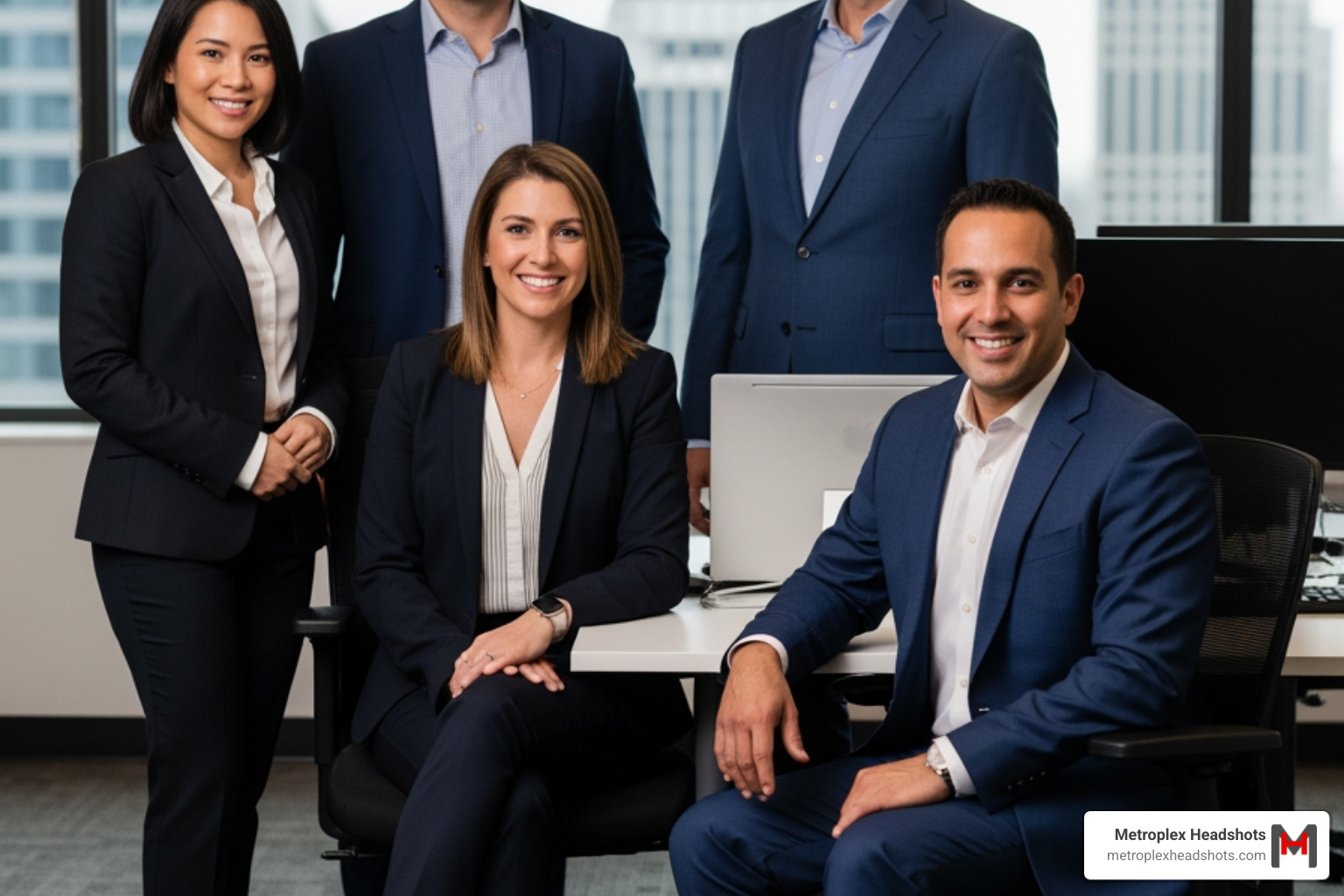
We also specialize in team portraits. To maintain consistent branding for a company in Southlake or Plano, we often use “composite” group shots. This involves photographing each executive individually and then digitally combining them. This way, if a board member leaves or a new VP is hired, we can update the group photo without re-shooting the entire team.
For more insights into the business side of things, browse our tag/business-portraits/ section.
Frequently Asked Questions about Executive Portrait Photography
How often should executives update their professional portraits?
Professional photographers recommend updating your portraits every 2-3 years. However, you should book a new session sooner if you have a significant change in appearance (new hair color, significant weight loss, or even new glasses), a major promotion, or if your company undergoes a total rebrand.
What is the best way to handle group executive portraits for a consistent brand?
Consistency is key for corporate branding. We recommend using the same lighting setup, background, and editing style for every member of the leadership team. As mentioned, composite portraits are the gold standard for large or evolving teams, as they allow for easy updates and perfect individual posing for every person in the “group.”
What licensing rights are typically included in a corporate portrait contract?
Most standard contracts grant you a non-exclusive, perpetual license for professional use across digital and print media (social media, websites, annual reports). It’s important to clarify if the license includes high-resolution files for print and if there are any restrictions on third-party use (e.g., giving the photo to a magazine for a feature).
Conclusion
At Metroplex Headshots, we understand that your time is your most valuable asset. That’s why we’ve designed our process to be as efficient and stress-free as possible. From our studio in the heart of the Dallas-Fort Worth Metroplex to our on-location services in Southlake, Westlake, and beyond, we are here to help you command the frame.
We don’t just take pictures; we craft the “CEO look” that opens doors and builds trust. With over 25 years of experience and a $4,000,000 liability insurance policy for corporate peace of mind, we are the trusted choice for DFW leadership.
Ready to elevate your professional presence with executive portrait photography? Whether you need a single portrait or a full team refresh, we offer same-day selection so you can see your best self immediately.
Book your executive session today and let’s create an image that works as hard as you do.

