Most corporate leaders treat headshots as a logistics task. Schedule the photographer, get everyone in front of the camera, post the photos to the website. Done. But that framing misses something significant. Understanding why corporate headshots support DEI branding means recognizing that employee imagery is one of the most visible signals your organization sends about who belongs here. When your visual representation aligns with a genuine commitment to diversity, equity, and inclusion, it builds trust with candidates, clients, and current employees. When it doesn’t, the gap is obvious. Inclusive companies attract better talent and retain employees at higher rates, making authentic visual representation far more than a cosmetic decision.
Table of Contents
- Key Takeaways
- Why corporate headshots support DEI branding beyond aesthetics
- Psychological and business benefits of consistent headshots
- Avoiding the pitfalls of performative visual inclusion
- Practical steps for HR and corporate leaders
- My perspective on headshots and authentic DEI culture
- How Metroplex Headshots supports your DEI branding goals
- FAQ
Key Takeaways
| Point | Details |
|---|---|
| Headshots signal inclusion | Employee imagery communicates who belongs at your company before a single word is read. |
| Consistency builds trust | Standardized headshot styling across diverse employees increases brand trust and social media engagement. |
| Authenticity prevents backlash | Visual DEI signals without internal commitment risk being seen as performative and can damage brand credibility. |
| Audit your protocols | Reviewing photography direction for unintended bias is a concrete step toward substantive inclusion. |
| Technology expands access | AI-assisted headshot tools can reduce logistical barriers and support equitable representation across global teams. |
Why corporate headshots support DEI branding beyond aesthetics
The phrase “DEI branding” gets used loosely, so it’s worth being precise. In professional practice, the recognized term is employer value proposition (EVP) communication, which encompasses every signal a company sends about its culture, values, and the people who work there. Corporate headshots are a core component of that communication. They appear on career pages, LinkedIn profiles, press releases, annual reports, and internal directories. Every one of those placements is an opportunity to either reinforce or undermine your stated DEI commitments.
Research published in the Journal of Business Ethics in 2026 found that racial minority representation in brand imagery drives higher positive social media engagement through what researchers call perceived brand morality. In other words, audiences don’t just notice who appears in your imagery. They draw conclusions about your organization’s values based on it. That’s a significant finding for HR professionals and branding specialists, because it means headshot decisions carry measurable business consequences.
The risk of getting this wrong is equally real. A 2026 HR Dive report quoted inclusion executives warning that superficial DEI communications without genuine internal commitment invite backlash rather than goodwill. Posting a diverse set of headshots while maintaining homogeneous leadership or inequitable workplace practices is a contradiction audiences increasingly recognize and call out.
Pro Tip: Avoid the trap of visual uniformity. When every employee is photographed in identical poses, lighting, and styling that favor one aesthetic standard, you may be inadvertently signaling conformity rather than inclusion. Flexible direction that respects individual identity is the foundation of authentic representation.
Psychological and business benefits of consistent headshots
There’s a behavioral psychology principle at work in how people respond to employee imagery. Cognitive ease, the mental comfort that comes from processing familiar patterns, is triggered when headshots across a team share consistent quality, background, and framing. That consistency signals organizational coherence. It tells viewers that this company pays attention, invests in its people, and operates with intention.
The business case is concrete. Consistent employee headshots increase brand trust, social media engagement, and sales conversion rates, according to research from Stanford Graduate School of Business and a 2026 Social Media Examiner study. When that consistency is applied across a genuinely diverse team, the combined effect is powerful. You’re communicating both organizational quality and authentic inclusion at the same time.

Technology is making this more achievable for large organizations. AI-assisted headshot tools can now maintain visual standards globally, reduce bias in image processing, and give employees in remote or international offices equitable access to professional-quality imagery. A 2026 Baker McKenzie testimonial highlighted how centralized governance workflows allowed their global team to maintain brand-compliant, culturally diverse imagery without requiring every employee to travel to a central photography studio.
Pro Tip: When managing headshot projects across multiple locations, use a centralized brief that specifies background, lighting tone, and framing standards. This reduces visual drift across offices while leaving room for individual expression in clothing and personal style.
Avoiding the pitfalls of performative visual inclusion
This is where the conversation gets uncomfortable, and it’s worth having directly. A 2026 Frontiers in Communication study found that corporate visual diversity often functions as impression management, selectively signaling inclusion while actually reproducing normative stereotypes in how subjects are posed, lit, and presented. That’s a precise description of what happens when companies photograph a diverse group of employees but apply a single “ideal” aesthetic standard to every image.
The intersectionality dimension matters here too. Employees bring multiple dimensions of identity to their professional image: race, gender expression, age, disability, cultural background. Photography direction that doesn’t account for this complexity can flatten those identities into a corporate-approved mold that feels alienating rather than welcoming.
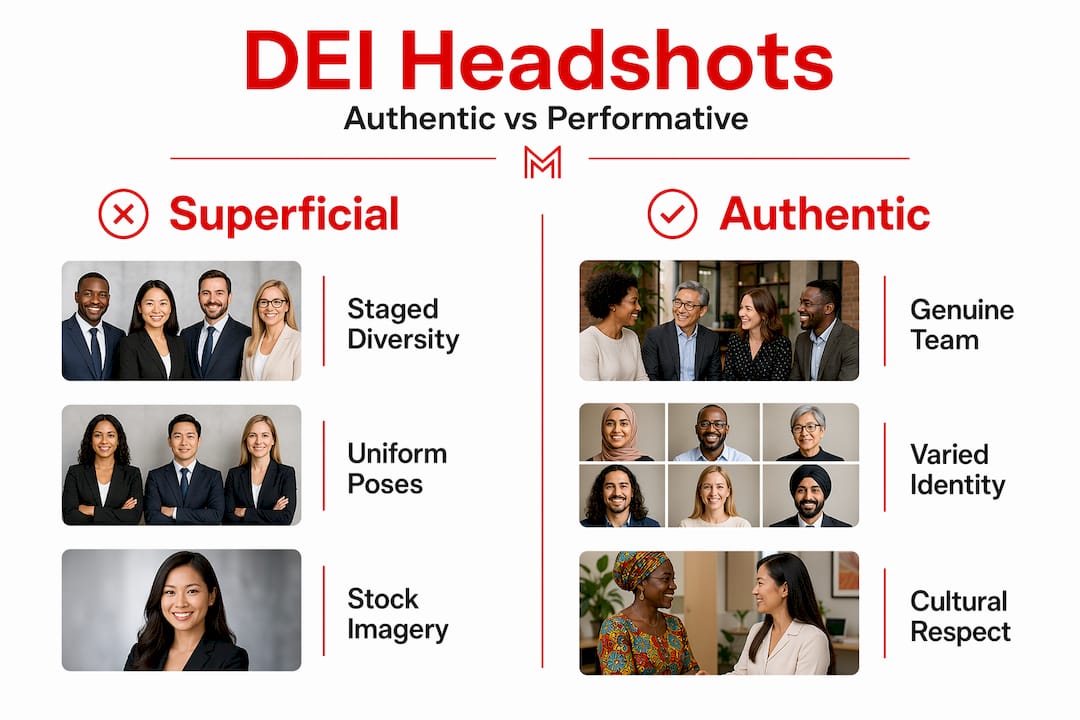
The following table contrasts superficial and substantive approaches to DEI-oriented headshot programs:
| Approach | Superficial DEI strategy | Substantive DEI strategy |
|---|---|---|
| Photography direction | Single pose and styling standard applied to everyone | Flexible direction respecting individual identity and cultural norms |
| Subject selection | Diverse faces, uniform presentation | Diverse faces with authentic, varied self-expression |
| Audit process | No review of imagery for unintended bias | Regular review of headshot protocols by HR and DEI leads |
| Internal alignment | Imagery does not reflect actual leadership diversity | Imagery reflects genuine organizational diversity at all levels |
| Outcome | Impression management risk, potential backlash | Authentic brand alignment, increased candidate and employee trust |
Auditing your headshot protocols is not a one-time task. As your team evolves and DEI standards advance, your photography direction should be reviewed accordingly. The impact of headshots on workplace culture is cumulative. Each image either reinforces or erodes the sense of belonging your employees experience when they see themselves represented, or not represented, in company communications.
Practical steps for HR and corporate leaders
Building a DEI-aligned headshot program doesn’t require starting from scratch. It requires intentionality at each stage of planning and execution. A 2026 Allianz case study demonstrated how reusable EVP image libraries deployed consistently across career pages and digital touchpoints supported both external DEI branding and internal culture reinforcement.
Here’s a practical framework for launching and sustaining a program that genuinely reflects your DEI commitments:
- Audit your current imagery. Pull every headshot currently in use across your website, LinkedIn, and internal directories. Assess demographic representation at every level, not just entry-level roles. Note any patterns in how different groups are presented.
- Define your photography brief with DEI in mind. Specify background, lighting, and framing standards, but write direction that accommodates diverse hair textures, skin tones, cultural dress, and personal style. Avoid language that implies a single “polished” look.
- Schedule sessions equitably. Remote employees, part-time staff, and employees at smaller offices should have the same access to professional headshots as headquarters staff. This is where AI-assisted tools or traveling photographers can close the gap.
- Involve your DEI team in the review process. Before images go live, have your DEI lead or an employee resource group review a sample for unintended bias in posing, expression, or presentation.
- Build a living image library. Corporate headshots are reusable EVP assets that should be refreshed as your team grows and changes. Treat them as a maintained asset, not a one-time project.
- Align imagery with internal reality. If your leadership team lacks diversity, addressing that is the work that makes the headshots credible. Imagery should reflect where you are and where you’re committed to going.
My perspective on headshots and authentic DEI culture
I’m Traci Schowmeyer, and I’ve photographed corporate teams across industries for years. Here’s what I’ve learned that most articles won’t tell you: the companies that get the most out of their headshot investments are the ones where leadership actually cares about the outcome beyond the deliverable.
I’ve worked with organizations that scheduled a company-wide headshot day, got beautiful, consistent images of a genuinely diverse team, and then used those images everywhere. Their career pages reflected their actual culture. Candidates showed up knowing what to expect. That alignment is rare, and it’s worth pursuing.
I’ve also seen the opposite. Companies that wanted “diverse headshots” as a checkbox item, where the photography brief was essentially “make everyone look the same, just with different faces.” The images looked fine on the surface. But they felt hollow, and so did the brand they represented.
What I’ve found actually works is treating the headshot session as a cultural moment, not just a production task. When employees feel respected in front of the camera, when the direction honors who they are rather than asking them to conform, the images carry that. You can see it. And so can every candidate, client, and partner who encounters those photos.
My take is this: headshots are one element of a DEI strategy, not a substitute for one. Use them strategically, align them with your internal practices, and they become one of the most cost-effective brand signals you have.
— Traci Schowmeyer
How Metroplex Headshots supports your DEI branding goals
At Metroplex Headshots, we understand that a professional headshot is more than a photo. It’s an extension of your brand and a direct reflection of your organizational values.
When you work with us on a corporate headshot package, you get more than consistent, high-quality imagery. You get a photographer who understands brand alignment, visual representation, and the nuances of photographing diverse teams with intention. Our approach is built around flexible direction that honors individual identity while maintaining the visual consistency your brand requires.
Whether you’re managing a company-wide session or need national headshot services for teams across multiple locations, Metroplex Headshots brings the experience and process to make your DEI-aligned imagery a genuine asset. We work with HR professionals, corporate leaders, and branding specialists who want their employee imagery to mean something. If you’re ready to build a headshot program that reflects who your organization actually is, we’re ready to help you get there.
FAQ
How do corporate headshots support DEI branding?
Corporate headshots make your organization’s diversity visible across every digital and physical touchpoint. Research shows that racial minority representation in imagery increases positive engagement through perceived brand morality, making diverse headshots a measurable driver of DEI brand credibility.
What makes a DEI headshot strategy authentic vs. performative?
Authentic DEI headshot strategies align visual representation with genuine internal inclusion practices at all organizational levels. Without that internal commitment, diverse imagery risks being read as impression management rather than true inclusion.
How often should companies update their corporate headshots?
Corporate headshots should be refreshed whenever significant team changes occur and reviewed annually as part of your EVP asset management. Treating them as a living library rather than a one-time project keeps your brand representation current and credible.
Can headshot styling unintentionally reinforce stereotypes?
Yes. Research published in Frontiers in Communication found that applying a single aesthetic standard to all employees can reproduce normative stereotypes even when subjects are visually diverse. Flexible photography direction is the practical solution.
What role does technology play in DEI-aligned headshot programs?
AI-assisted headshot tools support equitable access across global teams by maintaining consistent visual standards without requiring centralized photography sessions. This reduces logistical barriers that often result in uneven representation across office locations.
Recommended
- HR Managers: Corporate Headshots Are a Branding Investment
- Corporate Headshot Packages: Boost Your 2026 Image
- Corporate vs Business Headshots: What Executives Do Differently
- Company Wide Headshots: Top 2026 Guide