


Corporate headshot vendor selection is the structured process of evaluating photography service providers against your organization’s branding standards, logistical requirements, and procurement criteria to produce consistent, professional images at scale. This process involves key stakeholders across HR, marketing, and executive leadership, each bringing distinct requirements to the table. The decision touches everything from onsite versus studio session logistics to retainer pricing models and contract terms covering usage rights and cancellation policies. Getting this process right is the secret sauce of professional branding at the organizational level, and getting it wrong creates visual drift across your team’s public-facing profiles.
Corporate headshot vendor selection explained: the core framework
Corporate headshot vendor selection is not simply hiring a photographer you like. It is a procurement decision that requires the same rigor you apply to any vendor relationship affecting your company’s public image. The vendors you evaluate must demonstrate operational scale, brand alignment capability, and contract clarity before a single shutter clicks.
Three stakeholder groups typically drive this decision. HR manages scheduling and employee experience. Marketing owns brand consistency and deliverable specifications. Procurement handles contract terms, payment structures, and vendor compliance. When these three groups align on selection criteria upfront, the process moves faster and produces better outcomes. When they operate in silos, you end up with a vendor who delivers beautiful images in the wrong file format, on the wrong background, six weeks after your website relaunch.

The criteria for headshot vendor choice break into four categories: logistics, pricing, contract terms, and brand alignment. Each category carries equal weight. A vendor who excels at logistics but cannot deliver consistent color profiles across 200 employees is the wrong vendor for a corporate program.
How do you choose between onsite and studio headshot sessions?
Operational cost considerations should drive the onsite versus studio decision, not photographer preference. This distinction matters because the wrong choice multiplies your cost in ways that never appear on the photographer’s invoice.
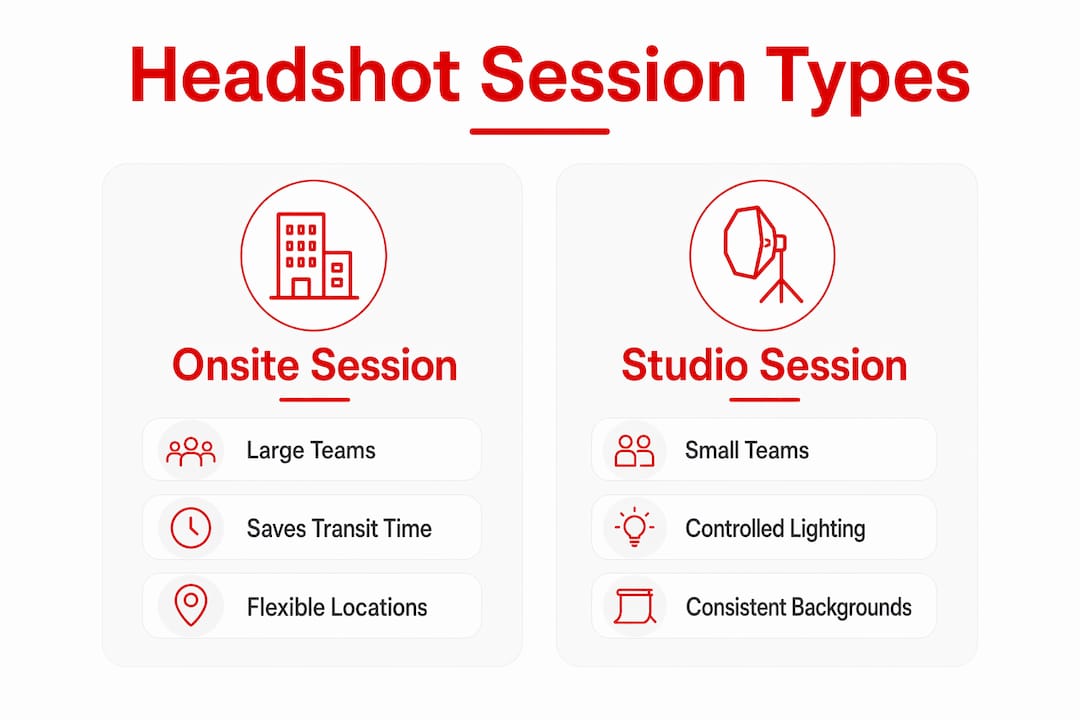
Onsite sessions suit teams of 20 or more because moving 50 people to a studio can consume a full day of productivity, while onsite setup costs roughly 10 minutes per employee. That math is straightforward for any operations leader. A portable lighting rig, a collapsible backdrop, and a controlled room in your office building produce images that match studio quality when the photographer is experienced with corporate environments.
Studio sessions serve a different purpose. Studio beats onsite for small groups of fewer than 10 executives or when a specific branded backdrop requiring complex setup is non-negotiable. Executive portrait sessions for C-suite leaders often benefit from the controlled environment and premium feel that a dedicated studio provides. The executive portrait photography experience differs meaningfully from a 10-minute onsite slot.
Pro Tip: Before committing to either format, calculate the fully loaded cost of employee transit time for a studio shoot. For a 30-person team at an average hourly rate of $75, two hours of round-trip transit equals $4,500 in productivity cost that never appears on the photographer’s quote.
| Factor | Onsite session | Studio session |
|---|---|---|
| Ideal team size | 20 or more employees | Fewer than 10 executives |
| Setup time | 60 to 90 minutes total | Pre-configured, minimal day-of setup |
| Productivity impact | Low (employees stay on-site) | Higher (transit time required) |
| Background flexibility | Limited to portable options | Full range of branded backdrops |
| Cost per head | Lower for large groups | Higher per person for small groups |
| Brand consistency | Strong with experienced vendor | Strongest for complex branded setups |
What pricing models do corporate headshot vendors use?
Corporate photography services selection requires a clear understanding of how vendors structure their fees, because the pricing model shapes your long-term budget as much as the per-session rate. Two primary models dominate the market: per-person project pricing and subscription retainer programs.
Corporate subscriptions with quarterly studio visits run approximately $150 to $250 per person and typically include retouching and delivery. This model suits organizations with regular employee turnover or ongoing hiring programs where new team members need headshots on a rolling basis. The predictable cost per quarter makes budget planning straightforward for finance teams.
Per-person project pricing works differently. Large team shoots are typically structured as a setup fee plus a per-head charge, which rewards volume. A vendor might charge a $500 setup fee and $85 per person for a 50-person shoot, bringing the effective cost per image down significantly compared to individual bookings. What is included matters as much as the rate. Confirm that retouching, a defined delivery timeline, and session duration are written into the agreement before you sign.
Pro Tip: Ask vendors to itemize retouching separately. Some vendors include basic skin retouching but charge extra for background replacement or color correction. Knowing this upfront prevents invoice surprises and lets you compare quotes on equal terms.
| Pricing model | Best for | Typical cost range | What is included |
|---|---|---|---|
| Per-person project rate | One-time or annual shoots | $85 to $300 per person | Session, basic retouching, digital delivery |
| Setup fee plus per head | Large teams (20 or more) | $500 setup plus $75 to $150 per person | Full session, retouching, formatted files |
| Quarterly subscription retainer | Ongoing hiring programs | $150 to $250 per person per quarter | Recurring sessions, retouching, priority scheduling |
| Executive premium package | C-suite or board portraits | $400 to $800 per session | Extended session, multiple looks, premium retouching |
What contract terms protect your organization in headshot agreements?
Standard corporate contracts include net-30 payment terms, cancellation fees scaled by notice period, and usage rights covering internal, web, press, and social media use in perpetuity. These three elements form the baseline. Any vendor who cannot provide them in writing is not operating at a corporate procurement standard.
Cancellation policy deserves specific attention. A 50% fee triggered within 14 days of the shoot date, escalating to 100% within 48 hours, is standard practice. This protects the photographer’s scheduling and your organization’s accountability. Build these terms into your internal approval process so that last-minute cancellations require sign-off from a budget owner.
Clear deliverable specifications prevent the costly revision loops that delay website launches and onboarding materials. Contracts should specify file type (JPEG and TIFF), minimum resolution (3,000 pixels on the long edge), and color profile (sRGB for web, Adobe RGB for print). Without these specifications, you will spend time chasing reformatted files instead of publishing them.
Booking platforms like HoneyBook and Tave support net-30 invoice workflows, unlike consumer portrait booking tools. Confirm that your vendor uses a system compatible with your accounts payable process before the contract is signed.
Here are the contract best practices that protect your organization and prevent costly disputes:
- Require net-30 payment terms in writing and confirm the vendor’s invoicing platform supports corporate AP workflows.
- Define cancellation fee thresholds clearly, including the notice period required to avoid each penalty tier.
- Specify usage rights explicitly: internal use, company website, press releases, LinkedIn, and any paid advertising use.
- List deliverable specifications by file type, resolution, and color profile for both web and print applications.
- Include a reshoot policy that defines the conditions under which the vendor will reshoot at no additional cost.
- Request proof of general liability insurance and confirm the vendor meets your organization’s vendor compliance standards.
- Define the delivery timeline in business days, not calendar days, and include a late delivery clause.
How do you align vendor selection with corporate branding and procurement standards?
Vendor selection must prioritize alignment with corporate procurement standards, including contract clarity and risk mitigation. This means treating your headshot vendor the same way you treat any supplier who touches your brand’s public output.
Corporate buyers value consistent lighting, crop, color, and brand-appropriate backgrounds, not creative range. This is a critical distinction when evaluating portfolios. A vendor with a stunning editorial portfolio but no corporate client history may struggle to deliver 80 consistent images in a single day. Ask to see examples of large team shoots, not just individual portraits.
Aligning your headshot program with internal branding guidelines requires collaboration between marketing and the vendor before the shoot date. Share your brand color palette, approved background options, and any existing headshot examples that represent the standard you want to maintain. This pre-shoot alignment prevents visual drift across departments and hiring cohorts.
Structured vendor lifecycle management improves service consistency by standardizing selection criteria, onboarding, performance monitoring, and offboarding. For headshot programs, this means setting KPIs such as delivery time, revision request rate, and employee satisfaction scores. Regular performance audits identify service gaps before they affect your next company-wide shoot.
Key considerations when integrating headshot vendor selection into your procurement process:
- Develop a vendor scorecard that weights logistics capability, portfolio consistency, contract compliance, and pricing transparency.
- Involve HR early to address scheduling logistics, employee communication, and accessibility needs.
- Require vendors to submit a sample contract before the RFP stage so legal review can happen in parallel with portfolio evaluation.
- Set a minimum vendor experience threshold, such as three or more years of corporate client work and a minimum team size served.
- Plan for company-wide headshot coordination by building scheduling templates and employee prep guides into the vendor onboarding package.
Key takeaways
Selecting the right corporate headshot vendor requires aligning logistics, pricing, contract terms, and brand standards before any session is scheduled.
| Point | Details |
|---|---|
| Onsite vs. studio decision | Base the choice on team size and productivity cost, not photographer preference. |
| Pricing model clarity | Confirm what retouching, delivery timelines, and file formats are included before comparing quotes. |
| Contract non-negotiables | Require net-30 terms, defined cancellation fees, usage rights, and deliverable specifications in writing. |
| Brand consistency standard | Share internal branding guidelines with vendors before the shoot to prevent visual drift across teams. |
| Vendor lifecycle management | Use KPIs and regular audits to monitor performance and maintain headshot quality over time. |
What I have learned from years of corporate headshot vendor work
I’m Traci Schowmeyer, and the single most common mistake I see organizations make is treating headshot vendor selection as a creative decision rather than an operational one. They spend weeks evaluating artistic style and almost no time reviewing contract terms or deliverable specifications. Then they are surprised when the images arrive in the wrong format three weeks after the agreed deadline.
The onsite versus studio debate is almost always settled by the numbers, not by aesthetics. I have worked with corporate teams who insisted on studio sessions for 40 employees because they wanted a premium feel. By the time you account for transit, scheduling coordination, and the productivity cost of pulling people off-site, the premium feel cost twice what an onsite session would have. The images were not twice as good.
What I have also seen is that the organizations with the strongest headshot programs treat their photographer as a long-term partner, not a one-time vendor. They share their brand guidelines, they provide feedback after each shoot, and they build the relationship over multiple sessions. That consistency shows in the images. When your LinkedIn profile, your website, and your conference materials all reflect the same visual standard, that is executive presence working at the organizational level. It is not accidental. It is the result of a vendor relationship managed with the same discipline you bring to any other business function.
— Traci Schowmeyer
How Metroplex Headshots supports your corporate headshot program
Metroplex Headshots works with organizations across the country to deliver consistent, brand-aligned headshots for teams of all sizes. Whether you need an onsite session for your full department or a premium studio experience for your executive team, the process is built around your brand standards, your schedule, and your procurement requirements.
From corporate headshot packages designed for ongoing hiring programs to national headshot services that scale across multiple office locations, Metroplex Headshots brings contract clarity, retouching standards, and scheduling support that align with how your organization actually operates. Every session is positioned to reflect your brand environment and the professional presence your team projects to clients, partners, and the market.
FAQ
What is corporate headshot vendor selection?
Corporate headshot vendor selection is the process of evaluating photography service providers against your organization’s branding, logistical, and procurement requirements to produce consistent professional images at scale. It involves assessing pricing models, contract terms, session formats, and deliverable specifications before committing to a vendor.
How do I decide between onsite and studio sessions for my team?
Base the decision on team size and productivity cost. Onsite sessions are more efficient for teams of 20 or more employees, while studio sessions suit smaller executive groups or shoots requiring complex branded backdrops.
What should a corporate headshot contract include?
A corporate headshot contract should include net-30 payment terms, cancellation fee thresholds by notice period, usage rights for web and press, deliverable specifications by file type and resolution, and a defined delivery timeline in business days.
How much do corporate headshot programs typically cost?
Ongoing corporate headshot subscription programs typically cost $150 to $250 per person per quarter, including retouching and delivery. Large one-time team shoots are often priced as a setup fee plus a per-head rate, which reduces the effective cost per image at higher volumes.
How do I maintain headshot consistency across a large organization?
Share your brand guidelines, approved backgrounds, and existing headshot standards with your vendor before each session. Use KPIs such as delivery time and revision request rate to monitor vendor performance, and conduct regular review meetings to address any quality gaps before they compound across hiring cohorts.

