Professional photo corporate culture alignment is the deliberate use of consistent, authentic photography to visually express and reinforce your organization’s workplace culture and brand identity. When your images reflect real people in real environments, they build the kind of trust that generic stock photos never can. Corporate leaders and HR professionals who treat photography as a cultural investment, not just a marketing checkbox, create a visual language that works across recruiting, internal communications, and client-facing channels. Metroplex Headshots works with organizations to ensure every image communicates who you are, what your environment looks like, and what emotion you want clients and employees to feel.
How does professional photography convey and reinforce corporate culture?
Photography communicates culture before a single word is read. When a prospective hire or client lands on your website, the images they see form an immediate impression of your values, your people, and your environment. Authentic corporate portraits convey personality, approachability, and professionalism in ways that influence both client confidence and employer branding.
The most effective corporate photography uses real employees in real workspaces. A candid shot of a team collaborating in an open office communicates transparency and energy. A formal portrait in a polished boardroom communicates authority and precision. Neither is wrong. The key is that the images match the culture you actually have, not the one you wish you had.

Candid lifestyle photos showing employees at work transform corporate communication from transactional to relational storytelling. That shift matters because clients and candidates want to feel a connection before they commit. Consistency in lighting, color palette, and composition across all images creates a recognizable visual identity that feels owned rather than assembled.
Key elements that make photography reinforce culture:
- Real employees, real spaces. Staged or stock imagery signals inauthenticity immediately.
- Consistent visual style. Matching backgrounds, lighting, and tone across all images creates cohesion.
- Candid and lifestyle shots. These show how people actually work, not just how they pose.
- Headshots alongside team photos. Both serve different purposes and together tell a complete story.
- Emotional consistency. Every image should convey the same core feeling, whether that is approachability, expertise, or energy.
Pro Tip: Brief your photographer on three words that describe your company culture before the shoot. Those words should guide every lighting and composition decision made on the day.
What are the key elements and techniques for aligning photography with workplace culture?
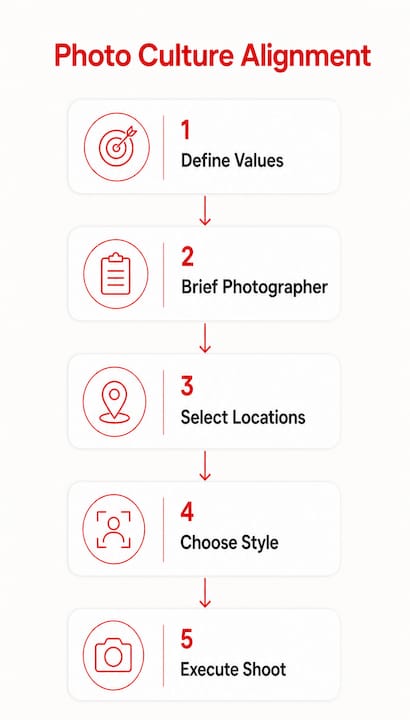
Aligning corporate photography with workplace culture requires planning before anyone picks up a camera. The process starts with defining what your culture actually looks like and what you want it to communicate externally. Without that clarity, even technically excellent images can feel disconnected from your brand.
A structured approach produces the most consistent results:
- Define your objectives. Identify the brand values and cultural attributes you want photography to express. Write them down before briefing any photographer.
- Select a photographer with corporate and cultural expertise. Not every skilled photographer understands brand alignment. Look for portfolios that show consistency across large teams and varied environments.
- Brief your team thoroughly. Guidance on clothing, grooming, and session flow increases comfort and produces more authentic images. Employees who know what to expect show up more relaxed and natural.
- Incorporate your visual identity. Brand colors, style guides, and approved backgrounds should inform every shoot. This is not about making images look like ads. It is about visual coherence.
- Balance polish with authenticity. The goal is professional craftsmanship that captures genuine expression, not a glossy veneer that feels distant. Authentic imagery resists polish for its own sake and emphasizes true story and connection.
- Use location strategically. Your office, your production floor, or your client spaces all tell different stories. Choose locations that reflect where your people actually do their best work.
Pro Tip: Create a one-page photography brief that includes your brand color palette, three culture words, approved locations, and dress code. Share it with every employee at least one week before the session.
Understanding how photo quality reflects brand values is the foundation of this entire process. Organizations that skip the briefing stage consistently produce images that feel mismatched with their stated culture.
How does aligned corporate photography impact internal culture and external branding?
The internal impact of photography is often underestimated. When employees see themselves honestly represented in company materials, their sense of pride and belonging increases. Repeated exposure to authentic employee photography reinforces culture and increases retention. That is a measurable return on a photography investment.
“Photography becomes a cultural tool when it helps people see themselves as part of something whole. OneSubsea used a unified photography style across diverse teams to create one coherent organizational identity.”
— Brandpie
The external benefits are equally concrete. Authentic team photography leads to stronger engagement and lower bounce rates on websites. Visitors stay longer when the imagery feels real. They trust the organization more when the people they see look like people they could actually work with.
Diversity, equity, and inclusion goals also connect directly to photography. Corporate headshots and team photos that reflect genuine inclusion reinforce trust and belonging for both current employees and prospective hires. When your imagery shows a workforce that looks like the world your clients live in, it signals that your culture matches your stated values.
Key impacts of aligned photography on culture and brand:
- Employee recognition and pride. People who see themselves in company imagery feel valued.
- Recruitment differentiation. Authentic team photos attract candidates who are a genuine cultural fit.
- Client trust. Real faces and real environments build credibility faster than polished abstractions.
- DEI visibility. Inclusive imagery makes internal inclusion practices visible to the outside world.
- Brand consistency. Aligned photography reduces visual drift across platforms and materials.
Consistent visual branding through team headshots is one of the most direct ways to signal organizational maturity to clients and partners.
Comparing photographic styles for culture alignment
Different photography approaches serve different organizational needs. Choosing the wrong style creates visual fragmentation, which dilutes both brand and cultural messaging.
| Style | Best for | Strengths | Limitations |
|---|---|---|---|
| Formal studio portraits | Law firms, financial services, executive teams | Consistent, polished, authoritative | Can feel cold or impersonal at scale |
| Environmental headshots | Tech, creative, and consulting firms | Shows real workspace, feels grounded | Requires controlled lighting in varied spaces |
| Candid lifestyle photography | Culture-forward brands, startups, HR recruitment | Relational, warm, shows actual work | Harder to maintain consistency across shoots |
| Mixed approach | Mid-size to large organizations | Covers all use cases, flexible | Requires strong art direction to stay cohesive |
The mixed approach works well for most organizations with more than 50 employees, but only when a clear style guide governs every shoot. Without that guide, a mixed approach produces visual fragmentation rather than richness. Brandpie’s work with SLB demonstrated this directly. A photography audit revealed fragmented imagery across global teams. The solution was not a single hero shoot. It was a consistent art direction standard that enabled strong imagery at every location.
Company size and industry should drive the style decision. A 10-person boutique consulting firm and a 5,000-person manufacturer need fundamentally different approaches, even if their stated values are similar.
Practical steps to implement professional photo culture alignment
Corporate leaders and HR professionals can follow a clear process to get this right without wasting budget on reshoots.
- Conduct a photography audit. Pull every image currently used across your website, LinkedIn, recruitment materials, and internal communications. Identify inconsistencies in style, lighting, and tone. This audit reveals the gap between your current visual identity and your stated culture.
- Set written photography standards. Document approved backgrounds, lighting styles, color palettes, and dress codes. These standards govern every future shoot, whether you have 10 employees or 10,000.
- Partner with a photographer who specializes in corporate and cultural work. General portrait photographers and corporate culture specialists produce very different results. Ask to see examples of multi-person team shoots before committing.
- Prepare employees and leadership before the session. Share the one-page brief described earlier. Hold a short briefing call for leadership to explain the cultural goals behind the shoot, not just the logistics.
- Use photography across internal channels. Intranet pages, all-hands presentations, and onboarding materials all benefit from consistent, authentic imagery. Photography for workplace culture works only when it appears where employees actually look.
- Schedule regular refreshes. Teams change. Culture evolves. A photography refresh every 18–24 months keeps your visual identity current and prevents the visual drift that undermines brand trust over time.
Leadership portrait alignment is a strong starting point for organizations that want to anchor their visual identity at the top before rolling out team-wide photography.
Key Takeaways
Aligned corporate photography builds trust, reinforces culture, and reduces visual drift when organizations treat it as a long-term investment governed by clear standards.
| Point | Details |
|---|---|
| Start with a photography audit | Identify visual fragmentation before investing in new shoots. |
| Write photography standards first | Document style, lighting, and dress code before briefing any photographer. |
| Authentic imagery outperforms polish | Real people in real environments build more trust than staged or stock photos. |
| Internal impact is measurable | Employees who see themselves represented honestly show higher pride and retention. |
| DEI and culture are inseparable | Inclusive imagery makes internal values visible externally and builds belonging. |
Why authenticity beats perfection every time
I’m Traci Schowmeyer, and after years of working with corporate leaders on photography that actually reflects who they are, the pattern I see most often is this: organizations spend significant budget on photography that looks impressive but feels hollow. The images are technically flawless. The lighting is perfect. And nobody believes them.
The organizations that get this right are the ones that resist the urge to make everything look aspirational. They photograph their actual offices, their actual teams, and their actual culture. Sometimes that means a conference room that is not architecturally stunning. Sometimes it means a team photo where not everyone is a model. That is exactly the point.
What I have found is that the secret sauce of professional branding is not perfection. It is recognition. When a prospective client or candidate sees your team and thinks “those look like real people I could work with,” you have already won the first impression. No amount of retouching produces that feeling. Only authenticity does.
The organizations I respect most treat photography as a long-term driver of corporate belief, not a one-time project. They build a visual language over years, not quarters. That language becomes an intangible asset that no competitor can copy because it is genuinely theirs.
— Traci Schowmeyer
How Metroplex Headshots supports your visual culture strategy
Metroplex Headshots works with corporate leaders and HR professionals who understand that every image is an extension of their brand.
Whether you are building a company-wide photography standard from scratch or refreshing an existing visual identity, Metroplex Headshots brings the corporate and cultural expertise to make every session count. The work goes beyond technical execution. Every shoot is guided by your brand values, your culture, and the impression you want to leave with clients and candidates. Explore the differences between headshots and portraits to understand which approach fits your organization’s goals. For teams distributed across multiple locations, national headshot services deliver consistent results wherever your people work.
FAQ
What is professional photo corporate culture alignment?
Professional photo corporate culture alignment is the practice of using consistent, authentic photography to visually represent and reinforce an organization’s workplace values and brand identity. It ensures that every image across internal and external channels reflects the culture you actually have.
How does corporate photography affect employee engagement?
Authentic employee photography increases pride and belonging when people see themselves honestly represented in company materials. Repeated exposure to aligned imagery reinforces culture and supports retention over time.
What is the difference between environmental headshots and studio portraits?
Studio portraits deliver a consistent, polished look suited to formal industries like law and finance. Environmental headshots show employees in their actual workspaces, which communicates culture and approachability more directly.
How often should a company refresh its corporate photography?
A photography refresh every 18–24 months keeps visual identity current as teams and culture evolve. Organizations that wait longer risk visual drift, where outdated imagery contradicts their current brand positioning.
How does photography support DEI goals?
Corporate headshots and team photos that reflect genuine workforce diversity make inclusion practices visible externally. Authentic representation builds trust and belonging for both current employees and prospective hires.