


Your First Impression Starts Before You Say a Word
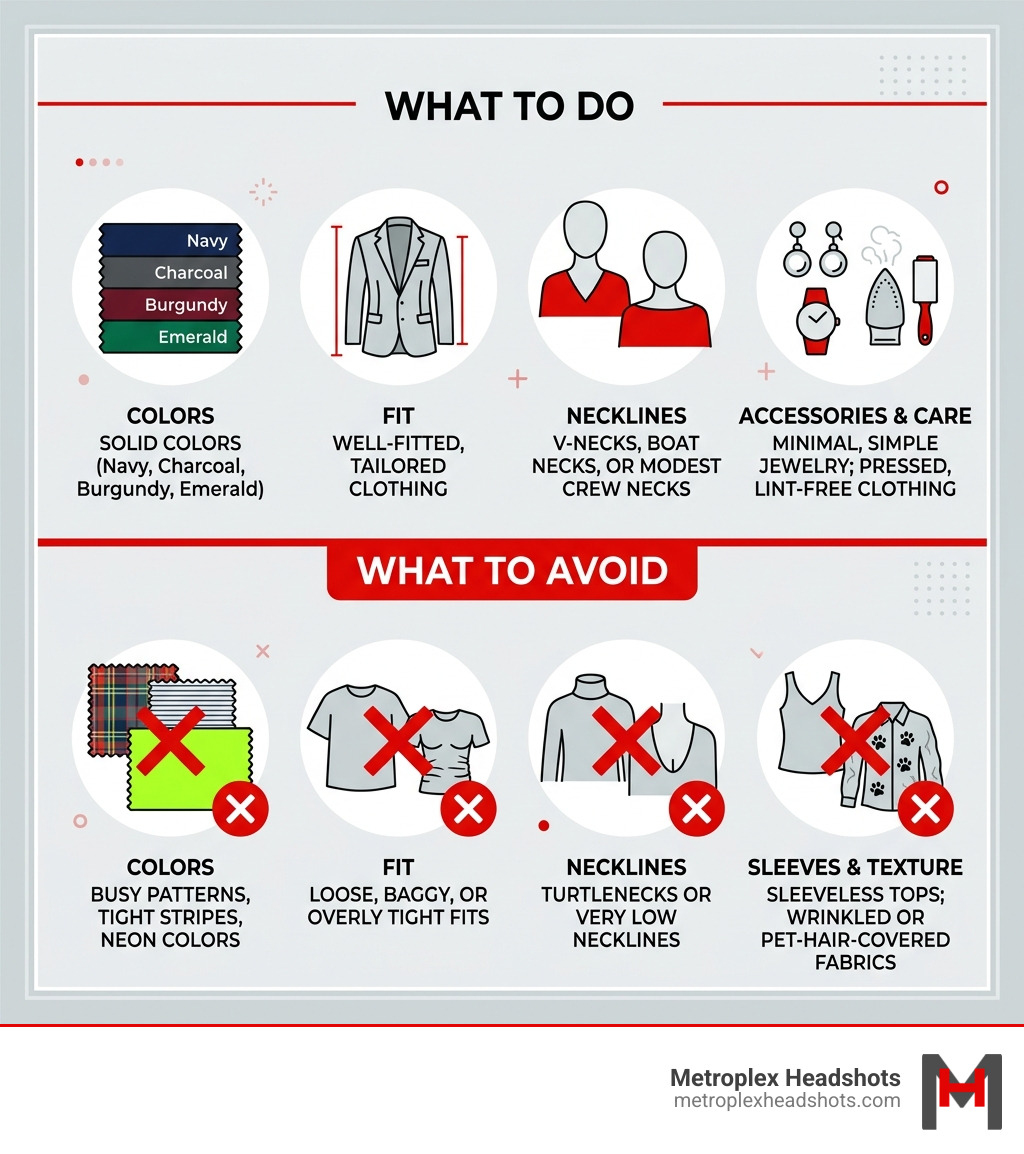
What to wear for a professional photo comes down to a few key principles: solid colors in navy, charcoal, or jewel tones; well-fitted, tailored clothing; flattering necklines like V-necks or boat necks; and minimal, non-distracting accessories.
Here’s a quick-reference guide:
| What to Do | What to Avoid |
|---|---|
| Solid colors (navy, charcoal, burgundy, emerald) | Busy patterns, tight stripes, neon colors |
| Well-fitted, tailored clothing | Loose, baggy, or overly tight fits |
| V-necks, boat necks, or modest crew necks | Turtlenecks or very low necklines |
| Three-quarter or long sleeves | Sleeveless tops or bare shoulders |
| Minimal, simple jewelry | Shiny, oversized, or distracting accessories |
| Pressed, lint-free clothing | Wrinkled or pet-hair-covered fabrics |
People form a first impression in as little as 100 milliseconds — and in the professional world, that judgment often happens through a screen. Consider that 20% of all time spent on LinkedIn is looking at profile pictures. Your headshot is working for you (or against you) long before anyone reads your bio.
The stakes are real. A strong headshot signals competence, approachability, and credibility. A poor one — or the wrong outfit — can quietly undermine all of that.
I’m Traci Schowmeyer, owner of Metroplex Headshots and a professional photographer with over 25 years of experience helping executives and professionals look their best on camera — including guiding hundreds of clients through exactly the question of what to wear for a professional photo. In this guide, I’ll walk you through everything I’ve learned, so you can walk into your session confident and camera-ready.
What to wear for a professional photo glossary:
What to Wear for a Professional Photo: Choosing Colors and Patterns
When you step into our studios in Dallas, Plano, or Fort Worth, the first thing the camera notices isn’t your smile—it’s the color you’re wearing. Color theory plays a massive role in how you are perceived.
For 90% of corporate environments, navy blue is the undisputed champion. It projects trust, stability, and confidence without the severity of pure black. Charcoal gray is a close second, offering a sophisticated, modern alternative that works beautifully against almost any background.
For those looking to add a bit more personality, jewel tones are your best friend. Think emerald green, royal blue, plum, or burgundy. These colors are saturated enough to look rich on camera but deep enough to remain professional. If you are a woman looking for specific advice on shades, it’s time to Ditch The Neon Finding The Best Colors For Womens Headshots.
Why Solids Outperform Patterns
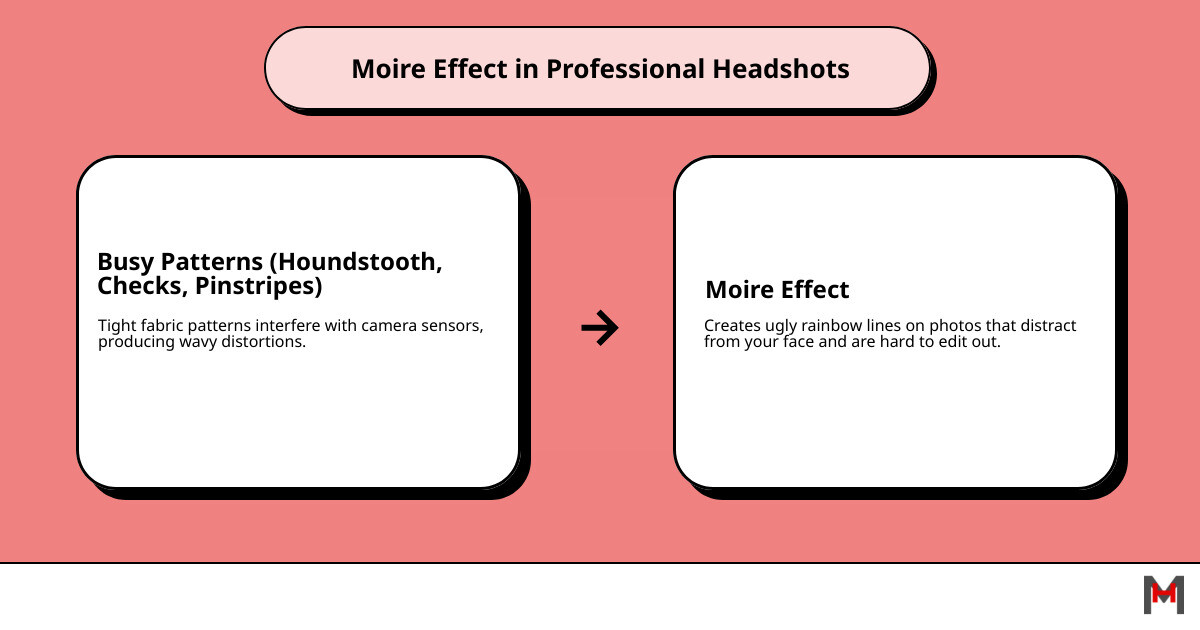
We often tell our clients from Southlake to McKinney: when in doubt, go solid. Busy patterns like houndstooth, small checks, or thin pinstripes can cause a phenomenon called the Moire effect. This happens when the camera’s sensor conflicts with the tight pattern of the fabric, creating wavy, rainbow-like lines that are nearly impossible to edit out.
Beyond technical issues, solids are timeless. A solid blazer will look just as professional in 2029 as it does in April 2026. Patterns tend to date quickly and can distract the viewer’s eye away from your face. What To Wear For A Good Headshot And Why Your Favorite Neon Shirt Is A Bad Idea often comes down to one thing: we want people to see you, not your shirt.
| Color | Psychological Impact | Best For |
|---|---|---|
| Navy Blue | Trust, Confidence, Stability | All Industries |
| Charcoal Gray | Sophistication, Neutrality, Logic | Finance, Law, Tech |
| Burgundy | Authority, Energy, Warmth | Leadership, Creative |
| Emerald Green | Balance, Growth, Reassurance | Wellness, Sustainability |
The Role of Neutrals and Black
Can you wear black? Absolutely. Black communicates power and sophistication. However, it can sometimes “disappear” into a dark background or look a bit heavy under studio lights. To avoid losing detail in the shadows, we recommend layering black with a lighter inner piece or choosing a fabric with a subtle texture like wool to catch the light.
Neutrals like cream, tan, or light blue are excellent for a softer, more approachable look. However, be cautious with pure white; it can overexpose easily and pull attention away from your eyes. An off-white or light blue shirt usually photographs much better than a stark white one.
Strategic Wardrobe Selection: Fit, Necklines, and Industry Standards
The camera is a master at detecting a poor fit. If your jacket is too large, the shoulders will sag, making you look smaller and less authoritative. If it’s too tight, it will pull at the buttons, creating distracting lines.
A tailored fit is essential for a professional silhouette. Your clothing should skim your body rather than hang off it. When Dressing For Success In Your Next Professional Photo, focus on the “three Cs”: Comfort, Confidence, and Clean lines.
Industry Standards for What to Wear for a Professional Photo
Your outfit should tell the story of your profession. If you’re a lawyer in Dallas or a financier in Plano, a dark suit and tie (or a structured blazer and blouse) is the gold standard.
However, if you’re in a creative field or a tech startup in Frisco, a full suit might actually look out of place. For these roles, “smart casual” is the way to go—think a high-quality sweater, a crisp button-down without a tie, or a structured knit top.
Industry-Specific Dress Codes:
- Finance & Law: Dark suits, conservative ties, white or light blue shirts.
- Technology & Startups: Dark jeans with a blazer, high-quality sweaters, or button-downs with open collars.
- Healthcare: Professional attire or clean, pressed scrubs/lab coats if that is your daily uniform.
- Creative Fields: Bold colors, interesting textures, and more relaxed silhouettes that reflect your personal brand.
For the gentlemen, we’ve put together a specific guide on going Beyond The Tie Crafting Your Perfect Mens Headshot.
Flattering Necklines and Sleeve Lengths
The neckline acts as a frame for your face. V-necks are universally flattering because they elongate the neck and draw the eye upward toward the face. Boat necks and modest scoop necks are also excellent choices for women.
Avoid turtlenecks, as they can “cut off” the head from the body and make the neck disappear in a tight crop. Similarly, very low necklines can look unprofessional when the photo is cropped for a LinkedIn thumbnail.
When it comes to sleeves, long or three-quarter lengths are best. Bare arms can often appear larger than they are on camera and can distract from your face. If you have a favorite sleeveless dress, simply pair it with a tailored blazer or cardigan. You can see examples of how these choices impact the final look in our guide to Shine Bright Crafting Your Perfect Womens Business Headshot.

Final Preparations: Grooming, Accessories, and Clothing Care
You’ve picked the perfect outfit, but the details are what make or break the shot. Preparation should start the night before your session.
Grooming and Makeup
Studio lighting is much stronger than natural light, which can sometimes wash out your features. For women, we recommend applying makeup slightly darker than your daily look—specifically your lipstick and eye makeup. Use a matte foundation to prevent unwanted shine, and keep a translucent powder on hand for touch-ups.
For hair, stick to a style you know and love. Avoid getting a haircut the day before; give it at least 3-5 days to settle. For men, a fresh shave on the morning of the shoot is usually best to avoid five o’clock shadow.
Accessories and Clothing Care
When it comes to jewelry, less is more. Small studs or a simple pendant necklace are perfect. Large, shiny earrings can create “hot spots” of reflected light that distract from your eyes.
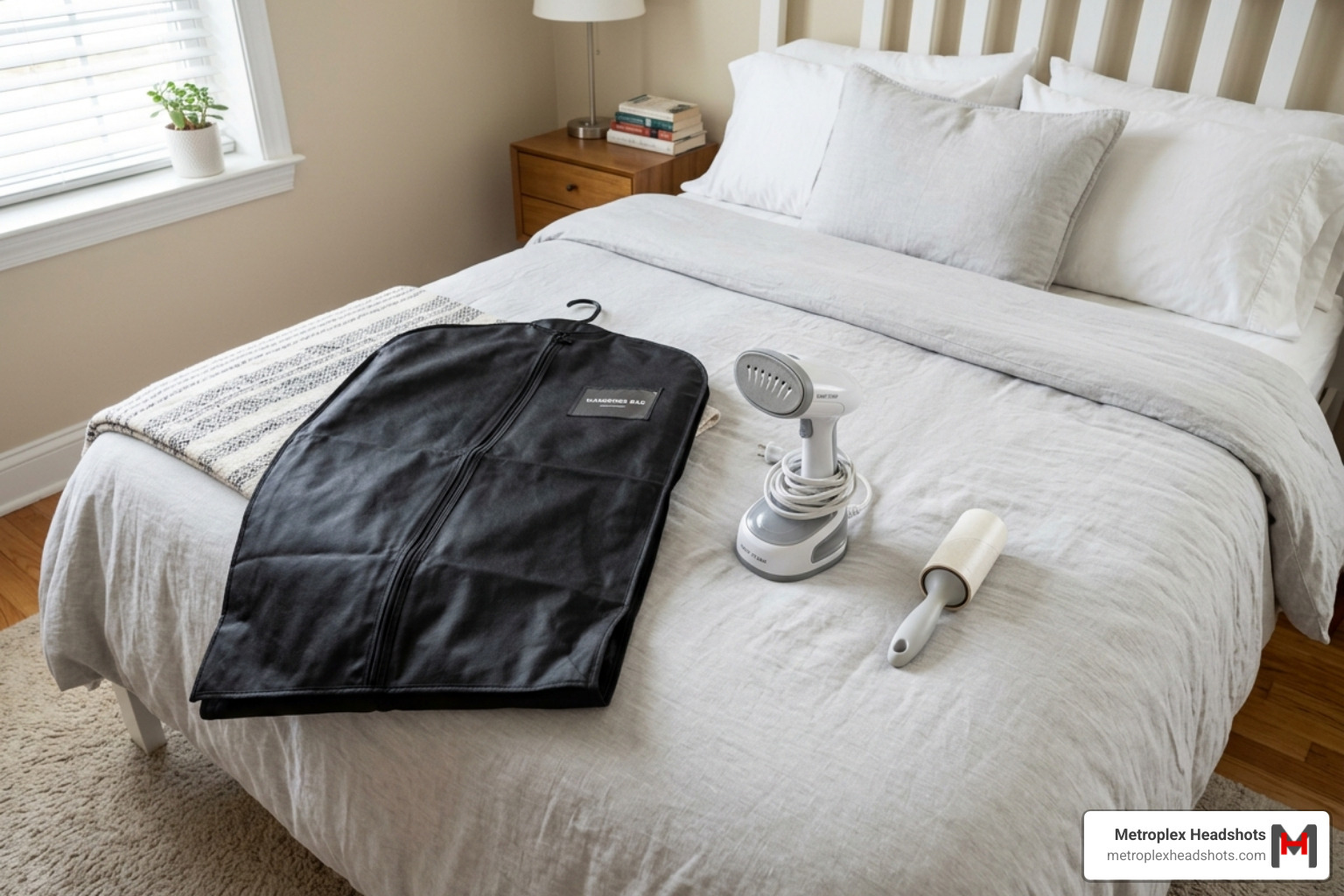
Before you leave for your session in Grapevine or Colleyville, ensure your clothes are perfectly pressed. Wrinkles are very difficult to remove in post-production. We always recommend bringing your clothes on hangers in a wardrobe bag rather than wearing them in the car to avoid seatbelt creases.
Pre-Shoot Checklist:
- Professional Headshot Session Prep Dressing For Success And Less Stress
- Use a lint roller (especially on dark fabrics!)
- Steam or iron everything the night before.
- Check for pet hair and loose threads.
Coordinating Team and Group Headshots
If you’re coordinating a team shoot for a company in Irving or Lewisville, consistency is key. You don’t want everyone in matching uniforms (unless that’s your brand), but you do want a cohesive level of formality.
If the CEO is in a suit, the rest of the leadership team shouldn’t be in t-shirts. Choose a shared color palette—perhaps everyone wears a variation of blue, gray, and white—to ensure your “About Us” page looks like a unified team rather than a collection of random photos.
Final Checklist for What to Wear for a Professional Photo
Before you head out the door, take one last look. Does your outfit align with your brand? Is it lint-free? Do you have multiple options? We always encourage our clients to Dress For Success And What To Wear For Your Next Professional Headshot by bringing at least 2-3 different looks. This gives us the flexibility to find the one that makes you shine the brightest.
Frequently Asked Questions about Professional Headshot Attire
Should I wear glasses or jewelry in my professional photo?
If you wear glasses every day, you should wear them in your photo! It’s part of your identity. To avoid glare, ensure your lenses have an anti-reflective coating. If they don’t, we can often tilt the frames slightly to manage reflections. For jewelry, keep it minimalist. The goal is to enhance your look, not compete with your face.
How many outfits should I bring to the shoot?
We recommend bringing 3-5 options. This allows us to try a variety of looks—perhaps one formal suit, one business-casual blazer/sweater combo, and one outfit that shows a bit more of your personal style. Layering is a great way to get multiple “looks” out of a single outfit change.
Is black or white better for a headshot?
Black is slenderizing and powerful, making it a great choice for many. White can be tricky because it can wash out skin tones and lose detail. If you love white, try an off-white, cream, or light gray, or wear a white shirt underneath a darker jacket for a crisp, high-contrast look that frames the face beautifully.
Conclusion
Your professional headshot is more than just a picture; it’s a strategic tool for your career. By choosing the right colors, ensuring a perfect fit, and preparing with care, you send a clear message to the world that you are a professional who pays attention to detail.
At Metroplex Headshots, we specialize in making this process easy. Whether you’re in Southlake, Westlake, or anywhere in the DFW Metroplex, our goal is to make you feel comfortable and confident so your true personality shines through.
Ready to update your professional image? More info about professional headshot packages is just a click away. We look forward to seeing you in the studio!

