


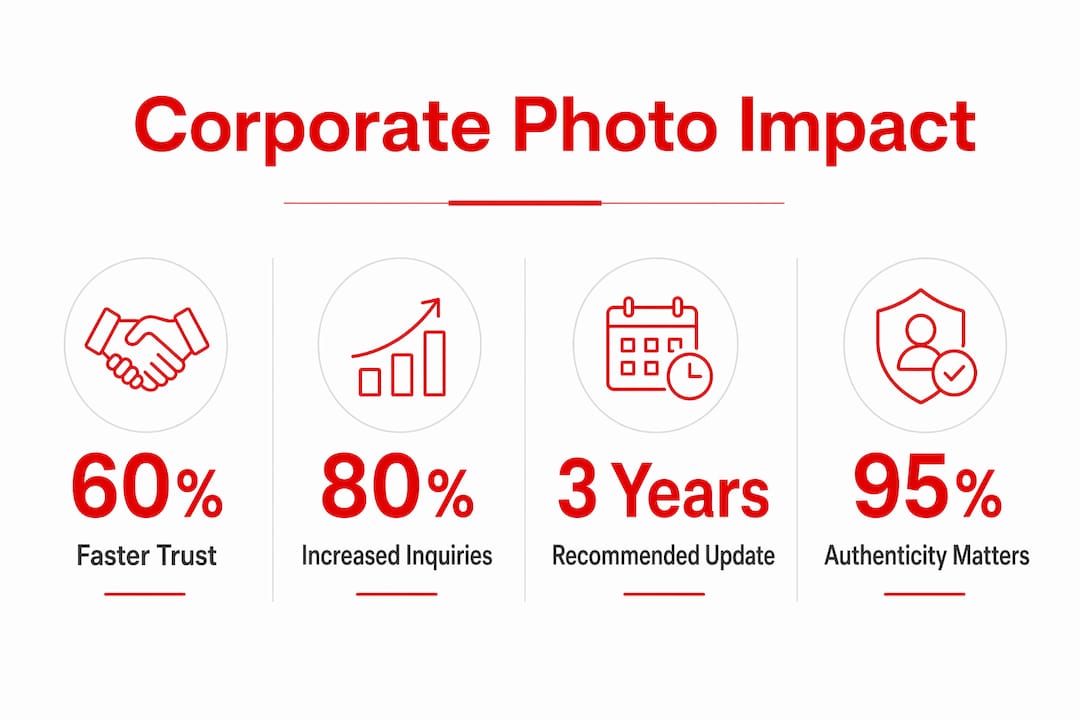
Corporate photos are the digital handshake your business extends before a single word is exchanged. Why corporate photos matter for client perception comes down to one hard truth: clients form judgments about your credibility before they read your bio, review your services, or respond to your proposal. Professional photography, specifically executive portraits and team images on platforms like LinkedIn and your company website, functions as a primary trust signal in an era when the Edelman 2025 Trust Barometer reports that 7 in 10 people believe leaders deliberately mislead them. That level of baseline skepticism means your visual presentation carries more weight than ever before.
How do corporate photos influence first impressions and client trust?
The neuroscience behind first impressions is unambiguous. Trustworthiness judgments from faces form within approximately 100 milliseconds, affecting perceptions of warmth, competence, and credibility before any conscious evaluation occurs. Willis and Todorov’s research confirms that the amygdala processes facial cues almost instantly, triggering social evaluations that shape whether a potential client leans in or clicks away.
This speed matters enormously for business professionals. A prospective client landing on your website or LinkedIn profile does not pause to consider your credentials. Their brain has already rendered a verdict. A poorly lit, outdated, or casually shot photo communicates low investment in your own brand, and by extension, low investment in theirs.
Website credibility judgments form in as little as 50 milliseconds, driven heavily by visual quality rather than content. That finding means your corporate photo is doing more persuasive work in a fraction of a second than your carefully written value proposition does in five minutes of reading.
Here is where the impact of professional photography becomes concrete:
- LinkedIn profiles with professional headshots receive significantly more connection requests and profile views than those with casual or absent photos.
- Company websites that feature real advisory or leadership team portraits consistently outperform those using stock imagery in perceived credibility and inquiry rates.
- Proposals and pitch decks that include professional executive portraits signal organizational maturity and executive presence to prospective clients.
- Email signatures with a polished headshot create a personal connection that reinforces trust across every touchpoint.
Pro Tip: Update your corporate headshot every two to three years, or immediately after a significant change in your appearance or role. Visual drift, the gap between how you look in a photo and how you appear in person, erodes trust the moment a client meets you face to face.
What role does corporate photography play in building a strong corporate image?

Corporate image is defined as the totality of stakeholder perceptions about an organization, shaped by visual identity, communication, behavior, and values working together. Meltwater’s research on corporate image confirms that professional images contribute directly to perceived trustworthiness and credibility over time, functioning as one of the most visible components of that identity system.
Corporate photography is not a standalone asset. It operates within a broader ecosystem that includes your brand colors, typography, messaging, and even your corporate social responsibility positioning. A 2026 thematic review of 21 peer-reviewed articles found that authenticity, coherence, and integration in corporate communication are the three pillars of sustained positive stakeholder perception. Photography that is inconsistent in style, lighting, or tone across your digital channels creates visual drift that undermines every other trust-building effort you make.
Consider the difference between a financial advisory firm that uses polished, consistent team portraits across its website, LinkedIn profiles, and client proposals versus one that mixes casual selfies, outdated headshots, and stock imagery. The first firm signals coherence. The second signals disorganization, regardless of the quality of its actual financial advice.
| Corporate image element | Role of professional photography |
|---|---|
| Visual identity | Reinforces brand colors, style, and tone consistently |
| Leadership credibility | Conveys executive presence and competence |
| Employee engagement | Signals that the organization values its people |
| Stakeholder trust | Provides authentic visual proof of the humans behind the brand |
| CSR and values alignment | Reflects organizational culture through authentic imagery |
Pro Tip: Treat your corporate photography session as a brand alignment exercise, not just a photo shoot. Brief your photographer on your brand values, your client base, and the emotion you want to convey. The resulting images will carry that intentionality in every frame.
Authentic photos vs. generic images: what clients actually perceive
Perceived authenticity is fragile. Audiences detect inauthenticity cues in visual content through contextual signals, inconsistencies in style, and the absence of recognizable human specificity. When a client sees a stock photo of a suspiciously perfect boardroom or a generic smiling professional who could represent any industry, their subconscious registers the absence of genuine identity. That registration weakens trust.
AI-generated imagery introduces an additional layer of risk. While AI headshots have improved technically, they lack the contextual authenticity that comes from a real person in a real environment. Audiences increasingly recognize the uncanny quality of AI portraits, and the association with inauthenticity can damage brand credibility more than a mediocre real photo would.
The contrast between authentic and generic imagery plays out clearly in client behavior. Case studies show that replacing stock photos with real advisory team photos boosted inquiries and perceived competence for professional services firms. The improvement was not marginal. It was the difference between a website that felt trustworthy and one that felt like a template.
| Image type | Client perception | Trust impact | Risk level |
|---|---|---|---|
| Custom professional headshot | Personal, credible, specific | High | Low |
| Authentic team photography | Relatable, transparent, human | High | Low |
| Stock photography | Generic, impersonal, interchangeable | Medium to low | Medium |
| AI-generated imagery | Uncanny, potentially deceptive | Low | High |
| Casual or selfie-style photos | Unprepared, low investment | Low | High |
The benefits of business portraits extend beyond aesthetics. A well-executed executive portrait communicates that you take your professional identity seriously, which signals to clients that you will take their business seriously too. That is not a soft benefit. It is a direct driver of inquiry, engagement, and conversion.
What practical steps optimize corporate photos for client perception?
Optimizing the importance of corporate images for your business requires a deliberate strategy, not a single photo session. The goal is brand alignment across every client touchpoint where your image appears.
Start with consistency. Photo consistency across digital channels strengthens brand coherence, enhances recognition, and supports client trust-building. That means your LinkedIn headshot, your website bio photo, your speaking profile image, and your email signature should all reflect the same visual identity, even if they are not identical shots.
Next, consider the environment your photo communicates. A real estate professional photographed in a modern office signals urban expertise. A financial advisor photographed in a warm, approachable setting signals accessibility. The background, lighting, and wardrobe in your corporate portrait are not incidental. They are part of the message. Metroplex Headshots approaches every session with this intentionality, working with clients to identify the environment and emotion that best reflects their brand.
Follow these practical guidelines to maximize the impact of your corporate photography investment:
- Align your photo style with your industry. Law firms and financial services firms benefit from formal, authoritative portraits. Creative agencies and tech startups can afford more relaxed, personality-driven imagery.
- Use consistent lighting and color treatment across all team photos to signal organizational cohesion.
- Integrate photos into every client touchpoint, including proposals, email signatures, social media profiles, and speaking bios.
- Avoid retouched images that no longer look like you. Clients who meet you in person after seeing an over-edited photo experience a trust gap that is difficult to recover from.
- Refresh photos after major role changes or when your current images are more than three years old.
Pro Tip: Before your next photo session, audit every platform where your image appears. Inconsistency across touchpoints is one of the most common and most damaging forms of visual drift in professional branding. A corporate photography workflow can help you plan for consistent deployment from the start.
Key takeaways
Corporate photos are a primary trust signal that clients process in milliseconds, making professional photography one of the highest-return investments in your brand credibility.
| Point | Details |
|---|---|
| First impressions form in milliseconds | Trustworthiness judgments from faces occur within 100 ms, before any content is read. |
| Authenticity drives trust | Custom portraits outperform stock and AI-generated images in perceived credibility and client inquiry rates. |
| Coherence across channels matters | Consistent photography across LinkedIn, websites, and proposals reinforces brand identity and reduces skepticism. |
| Photos are a strategic brand asset | Corporate photography integrates with values, CSR, and communication to shape long-term stakeholder perception. |
| Visual drift destroys trust | Outdated or inconsistent photos create a gap between expectation and reality that erodes client confidence. |
What I’ve learned coaching executives on their corporate image
I’m Traci Schowmeyer, and after years of working with business professionals on their visual brand identity, the pattern I see most often is not bad photography. It is underestimated photography. Executives spend thousands on website design, brand strategy, and marketing copy, then use a photo taken at a conference three years ago as their primary trust signal.
Here is what that communicates to a prospective client: the details do not matter to you. And if the details do not matter in how you present yourself, why would they matter in how you serve them?
The most effective corporate photos I have seen are not the most expensive or the most technically perfect. They are the ones where the subject understood what they were communicating before the shutter clicked. They knew their audience, their brand values, and the emotion they wanted to convey. That preparation is the secret sauce of professional branding, and it shows in every frame.
The Edelman trust data confirms what I observe every day: clients are skeptical by default. Your corporate photo is often the first piece of evidence they use to decide whether you are worth their time. Treating it as an afterthought is a costly mistake. Treating it as a strategic investment is one of the fastest ways to accelerate credibility and shorten the sales cycle.
Corporate photography is not about vanity. It is about giving your clients a reason to trust you before you have earned it through experience.
— Traci Schowmeyer
How Metroplex Headshots helps you build client trust through photography
Your corporate photo is an extension of your brand, and it deserves the same strategic attention you give every other client-facing asset.
Metroplex Headshots specializes in executive portraits and team photography designed to communicate your professional identity with precision. Every session is guided by your brand values, your client base, and the specific impression you want to make. Whether you need a single executive headshot or a full team photography package, the process is built around what your clients will ultimately think when they see your image. Explore the difference between headshot and portrait options to find the right fit for your brand, and take the first step toward a visual identity that earns trust before you say a word.
FAQ
Why do corporate photos matter for client perception?
Corporate photos are processed by the brain within 100 milliseconds, triggering instant judgments about warmth, competence, and credibility. Clients use these visual cues to decide whether to engage with your business before reading a single word of your content.
How do authentic photos compare to stock images for client trust?
Authentic custom portraits consistently outperform stock photography in perceived credibility and client inquiry rates. Audiences detect inauthenticity cues in generic imagery, which weakens the trust association with your brand.
How often should I update my corporate headshot?
Update your corporate headshot every two to three years, or immediately after a significant change in appearance or role. Visual drift between your photo and your actual appearance creates a trust gap when clients meet you in person.
What makes a corporate photo effective for brand alignment?
An effective corporate photo reflects your industry, communicates your brand values, and conveys the emotion you want clients to associate with your business. Consistency in lighting, style, and tone across all platforms reinforces that alignment.
Does photo consistency across platforms really affect client perception?
Consistent corporate photography across LinkedIn, your website, and client proposals strengthens brand coherence and reduces the skepticism clients bring to first interactions. Inconsistency signals disorganization, regardless of the quality of your actual work.

