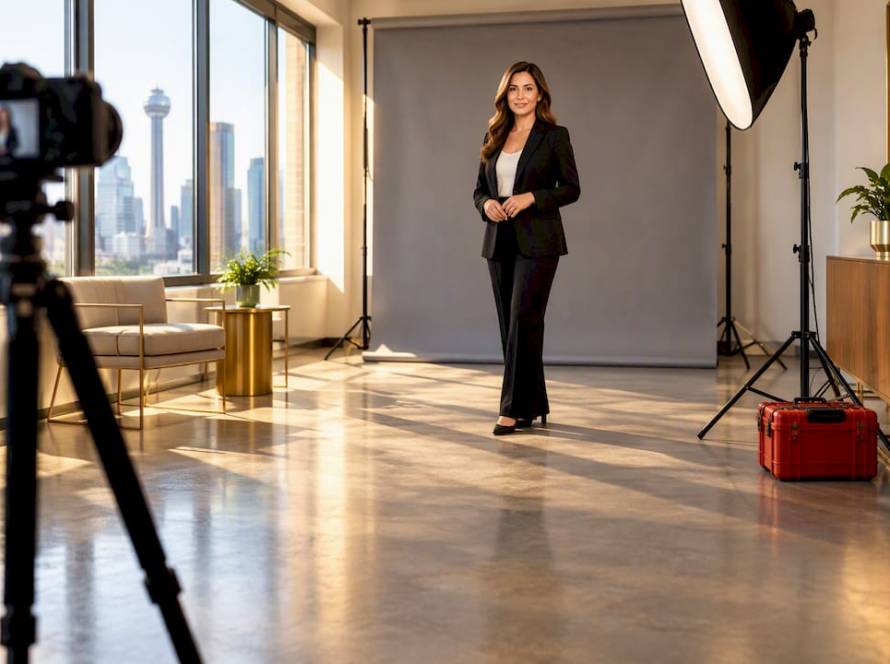
A corporate headshot for recruitment marketing is a professional portrait designed to represent your company’s employer brand and attract qualified candidates before they ever speak to a recruiter. Companies with consistent team photography on careers pages see a 34% higher application completion rate, along with 24% longer session duration and a 41% reduction in time-to-hire for client-facing roles. That data reframes the headshot from a nice-to-have into a direct hiring tool. Whether you work with a professional photographer like Metroplex Headshots or explore AI platforms such as HeadshotPro, brand consistency across every portrait is what drives those results.
What does a corporate headshot program for recruitment marketing require?
The industry term for what most HR teams are building is an employer brand photography program. A corporate headshot for recruitment marketing is the most visible output of that program, but the infrastructure behind it determines whether the images actually hold up over time.
Getting this right requires three departments working from the same playbook.
- HR defines the use cases: careers pages, LinkedIn, offer letters, onboarding portals, and job board profiles.
- Marketing sets the visual standards: background color, lighting style, clothing guidelines, and approved editing presets.
- IT handles the technical layer: storage, HRIS integration, and access permissions so photos reach the right systems automatically.
Without that cross-departmental alignment, you end up with what photographers call visual drift. One team has white backgrounds, another has gray, and a third submitted smartphone selfies. Candidates notice. A corporate photography workflow built on shared brand guidelines prevents that drift before it starts.
On the technology side, you have two primary options. Traditional professional photography, where a photographer like Metroplex Headshots visits your office or you bring employees to a studio, delivers the highest quality and the most control over executive presence and expression. AI headshot platforms such as HeadshotPro and StudioShot allow employees to submit smartphone photos and receive polished, brand-aligned portraits within hours. Both approaches have a place depending on your team size, budget, and timeline.

Pro Tip: Before your first headshot session, build a one-page brief that covers approved backgrounds, clothing colors to avoid, and the exact crop dimensions required by your careers page and LinkedIn. Distribute it to employees at least five business days in advance.
For growing teams, scalability is the deciding factor. A company-wide headshot guide should account for new hires, promotions, rebrands, and leadership changes so your imagery never falls behind your actual team.
How to execute a headshot strategy that strengthens hiring
Execution is where most HR teams lose momentum. The logistics feel manageable until you are coordinating 40 employees across three departments while trying to keep the business running.
A structured approach solves that. Follow these steps to run a headshot program that delivers brand-aligned portraits without disrupting operations.
- Audit your current imagery. Pull every photo from your careers page, LinkedIn company page, and job postings. Identify inconsistencies in background, lighting, and crop. This audit becomes your before-and-after benchmark.
- Set a single visual standard. Choose one background color, one lighting style, and one crop ratio. Document it in writing so every photographer or AI platform you use works from the same spec.
- Schedule headshot day in blocks. Professional sessions typically take 3 to 4 hours for a 15-person team. Book employees in 10-minute slots and send a preparation guide covering attire, grooming, and what to expect.
- Add environmental and candid shots. Formal portraits tell candidates who works there. Authentic team photos tell them what it feels like to work there. Both are necessary for modern recruitment marketing.
- Build an approval workflow. Route final images through HR and marketing before they go live. This step catches off-brand edits and protects visual consistency at scale.
- Schedule refresh cycles. Tie photo updates to annual performance reviews, major hiring campaigns, or leadership changes so your imagery never becomes stale.
Pro Tip: Send employees a short video walkthrough of what a headshot session looks like. Employees who know what to expect arrive more relaxed, and relaxed employees produce better portraits.
The table below compares the two primary execution models so you can choose the right fit for your team.
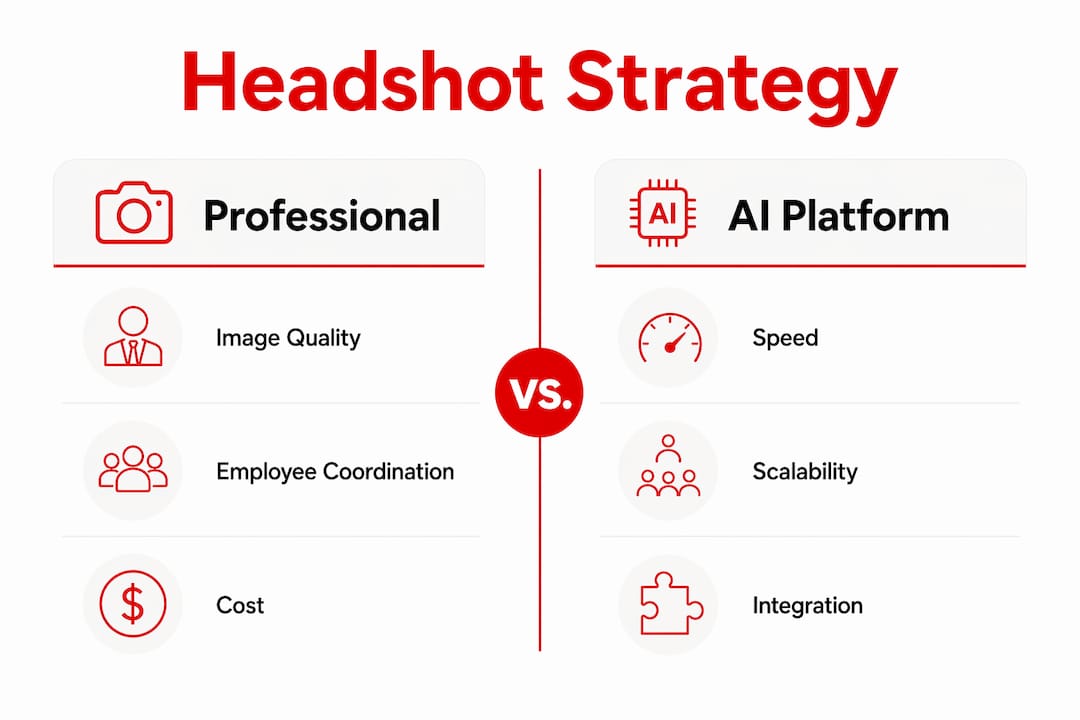
| Factor | Professional photography session | AI headshot platform |
|---|---|---|
| Image quality | Highest, with full lighting control | High, dependent on submitted photo quality |
| Turnaround time | Same day to 48 hours | Minutes to a few hours |
| Cost per person | Higher, includes photographer and editing | Lower, scales well for large teams |
| Brand control | Direct, guided by photographer | Template-based, consistent at volume |
| Best use case | Executive portraits, leadership pages | Rapid onboarding, distributed teams |
What challenges do HR teams face with headshot programs?
Even well-planned programs run into friction. Knowing the common failure points in advance lets you build solutions into your process rather than react to problems after they surface.
- Inconsistent photo quality across locations. Remote and distributed teams often submit photos taken in different lighting conditions, against different backgrounds, and at different resolutions. The result is a careers page that looks like it belongs to three different companies. Standardized submission guidelines and AI-based style normalization both address this directly.
- New hire photo gaps. When a new employee’s portrait is missing from the team page for their first two weeks, it signals disorganization to candidates researching your company. Integrating headshot submission into the onboarding checklist solves this. The photo is collected and approved before the employee’s second week.
- Employee resistance. Some employees dislike being photographed. Others simply deprioritize the task. Framing the headshot as a professional benefit rather than a company requirement increases compliance. Employees who receive professional portraits report a 29% improvement in professional confidence, and many share their photos voluntarily on LinkedIn, which extends your employer brand organically.
- Delayed updates after promotions or rebrands. A VP promoted six months ago who still has a coordinator-era headshot on the leadership page creates a credibility gap. Automated HRIS triggers that flag photo updates when job titles change prevent this from becoming a recurring problem.
- Over-retouching that removes authenticity. Candidates want to recognize the people they will work with. Heavy retouching that removes natural features or expressions creates a disconnect between the portrait and the real person. The goal is polished, not artificial.
How does AI headshot technology transform recruitment photography?
AI-generated corporate portraits have moved from novelty to practical infrastructure for HR teams managing large or distributed workforces. Platforms like HeadshotPro processed over 2 million business headshots in 2025 alone, offering custom brand styles, bulk processing, and real-time approval workflows. That volume signals that this technology is no longer experimental.
The core advantage is speed without sacrificing brand alignment. Traditional photography reduces employee coordination time by up to 50% compared to decentralized individual photo collection. AI platforms push that efficiency further by reducing photo generation time from weeks to hours. For a company hiring 200 people per quarter, that difference is measurable in both cost and time-to-fill.
| Metric | Before AI headshot integration | After AI headshot integration |
|---|---|---|
| Time to publish new hire photo | 2 to 4 weeks | Same day to 24 hours |
| Brand consistency score | Variable | Standardized across all portraits |
| Coordination hours per hire | 2 to 3 hours | Under 30 minutes |
| Application completion rate | Baseline | Up to 34% higher with consistent imagery |
Integration with HRIS platforms is where AI headshot tools deliver their most practical value for HR teams. When a new hire completes onboarding paperwork in Workday or BambooHR, an automated trigger can prompt the headshot submission workflow, route the image through an approval queue, and publish the approved portrait to the careers page and LinkedIn without manual intervention. That kind of automation removes the human bottleneck that causes most photo gaps.
Security and compliance deserve attention here. Any platform processing employee photos must meet your organization’s data privacy standards, including GDPR compliance for international teams and SOC 2 certification for enterprise environments. Vet platforms on these criteria before deployment.
Pro Tip: When evaluating AI headshot platforms, request a sample batch using photos from your actual team before committing. The output quality varies significantly depending on the training data each platform uses, and your employees deserve portraits that look like them.
How to maintain headshot assets that keep supporting recruitment
A headshot program is not a one-time project. It is an ongoing asset that requires the same maintenance discipline as your careers page copy or your job description templates.
- Tie refresh cycles to business events. Schedule photo updates to coincide with major hiring campaigns, annual reviews, leadership transitions, or rebrands. This keeps imagery current without requiring a separate calendar of photography events.
- Track the impact on recruitment metrics. Sales professionals with professional headshots achieve 23% higher LinkedIn outreach response rates. Apply the same measurement discipline to your careers page. Monitor application completion rates, time-on-page, and qualified lead volume before and after photo updates to quantify the return.
- Incorporate culture photography alongside formal portraits. Environmental and candid team photos show candidates the real texture of your workplace. A mix of formal headshots and authentic behind-the-scenes imagery positions your company as a destination employer rather than a faceless organization.
- Train HR and marketing teams on quality control. Build a short approval checklist that covers crop, background, lighting consistency, and expression. Anyone reviewing photos should apply the same criteria so approval decisions are consistent across reviewers.
- Budget for photography as a recurring line item. Companies that treat headshots as a one-time expense end up with outdated imagery within 18 months. A modest annual budget for a professional headshot session or AI platform subscription keeps your employer brand current without emergency spending.
Pro Tip: Create a shared photo asset library in Google Drive or SharePoint with clearly labeled folders by department, year, and approved use case. This prevents marketing from using outdated photos and gives HR a single source of truth for all portrait assets.
Key takeaways
A corporate headshot program built on brand consistency, structured workflows, and regular updates directly increases application rates, reduces time-to-hire, and strengthens employer brand credibility.
| Point | Details |
|---|---|
| Consistency drives applications | Consistent team photography produces a 34% higher application completion rate on careers pages. |
| Onboarding integration prevents gaps | Adding headshot submission to onboarding checklists delivers brand-aligned photos before an employee’s second week. |
| AI platforms scale efficiently | Tools like HeadshotPro reduce photo generation from weeks to hours, supporting rapid hiring cycles. |
| Culture photos amplify formal portraits | Environmental and candid shots show candidates what your workplace actually feels like, not just who works there. |
| Maintenance requires a budget line | Treating headshots as a recurring investment rather than a one-time project keeps employer brand imagery current. |
Why headshots are the most underestimated tool in your hiring stack
I’m Traci Schowmeyer, and after years of working with HR teams and businesses on professional photography, the pattern I see most often is this: companies spend thousands on job board advertising and nearly nothing on the imagery candidates encounter the moment they land on a careers page. That is a backwards allocation.
Candidates today research companies the way consumers research products. They look at your team page, your LinkedIn profiles, and your social feeds before they decide whether to apply. A careers page with mismatched, low-resolution, or outdated portraits signals one thing: this company does not pay attention to detail. That impression transfers directly to how candidates perceive your culture and management.
What I have found in practice is that the headshot is the digital handshake between your company and a prospective hire. It sets the tone before a single word of your job description is read. When I work with organizations to integrate professional photography into their onboarding and recruitment workflows, the shift in candidate engagement is immediate and measurable.
The AI tools available in 2026 are genuinely impressive, and I recommend them for distributed teams and high-volume hiring. But for leadership pages, executive profiles, and any image that will represent your company in a first impression context, a professional session with a skilled photographer still delivers something AI cannot fully replicate: the specific, intentional expression that communicates exactly who you are and why someone should want to work with you.
Make headshots a cornerstone of your employer branding strategy. The data supports it, and the candidates you want to attract are already expecting it.
— Traci Schowmeyer
How Metroplex Headshots supports your recruitment photography goals
Metroplex Headshots specializes in corporate and executive portrait sessions designed to align with your employer brand and support your hiring goals. Whether you need a full team photographed in a single morning or executive portraits that project the right level of authority and approachability, every session is built around what your candidates and clients will ultimately think when they see your team.
From national headshot services for distributed teams to on-site corporate sessions in the Dallas-Fort Worth area, Metroplex Headshots brings the structure and brand alignment your recruitment marketing requires. Every portrait is retouched, approved, and delivered in the formats your careers page, LinkedIn, and marketing materials need. Contact Metroplex Headshots to schedule a consultation and build a headshot program that works as hard as your recruiting team does.
FAQ
What is a corporate headshot for recruitment marketing?
A corporate headshot for recruitment marketing is a professional portrait used to represent your employer brand on careers pages, LinkedIn, and job postings, with the goal of attracting qualified candidates. Consistent, high-quality team photography is directly linked to higher application completion rates and shorter time-to-hire.
How often should companies update employee headshots?
Companies should refresh headshots at least once per year, or whenever a significant hiring campaign, rebrand, or leadership change occurs. Outdated photos create credibility gaps that candidates notice during their research process.
Can AI-generated headshots replace professional photography for hiring?
AI headshot platforms like HeadshotPro work well for distributed teams and high-volume onboarding because they deliver brand-consistent portraits quickly and at scale. For executive profiles and leadership pages where executive presence and authentic expression matter most, a professional photography session still produces superior results.
How do headshots affect LinkedIn recruitment outreach?
Sales and recruiting professionals with professional headshots achieve 23% higher LinkedIn outreach response rates compared to those with low-quality or missing photos. This makes the headshot one of the highest-return investments in a recruiter’s personal brand toolkit.
What should HR include in a headshot brand guideline document?
A headshot brand guideline should specify the approved background color, lighting style, clothing colors to avoid, required crop dimensions, and the approval workflow before any photo goes live. Distributing this document to employees before a session reduces reshoots and keeps all portraits visually consistent.