


Your headshot is a digital handshake. Before a prospect reads your bio, reviews your credentials, or speaks with your team, they have already formed an impression based on that single image. Research confirms that visual cues like attire, background, and expression drive snap judgments about competence and trustworthiness, often independent of actual performance. What your headshot says about company professionalism comes down to four signals your audience reads instantly:
- Reliability: A polished, well-lit portrait signals that your business pays attention to detail.
- Competence: Sharp framing, confident expression, and appropriate attire communicate that you take your work seriously.
- Approachability: A genuine, warm expression invites connection rather than creating distance.
- Brand alignment: When your headshot matches your company’s visual identity, it reinforces organizational cohesion across every platform where clients encounter you.
Get these four signals right, and your portrait does real selling work before you say a word.
How headshots shape your company’s brand image
Corporate headshots do more than identify individuals. They function as a unified visual system that tells clients, partners, and prospects what kind of organization they are dealing with. When every team member’s portrait shares consistent lighting, color temperature, and framing, the company projects a polished, organized culture. When those portraits vary wildly in style, the message is fragmentation, not professionalism.
High-quality corporate portraits signal that a company invests in its public image. That investment reads as confidence. Clients in service industries, where expertise and rapport drive selection, respond to that confidence by extending trust before the first conversation even happens.
- Visual cohesion: Matching backgrounds, attire tone, and lighting style across a team page communicates organizational discipline.
- Brand credibility: Consistent portraits reinforce the same reliability cues as your logo, typography, and color palette.
- Competitive differentiation: In crowded professional marketplaces, a polished headshot program sets your team apart from competitors whose profiles look assembled at random.
- Recognition: Uniform portraits help clients quickly scan a team, recognize roles, and build familiarity with the people they will work with.
The benefits of professional team headshots extend well beyond aesthetics. They are a branding investment with measurable returns in client trust and recognition.

What makes a headshot actually look professional?
The difference between a headshot that builds confidence and one that quietly undermines it comes down to a handful of technical and creative decisions. None of them are accidental.
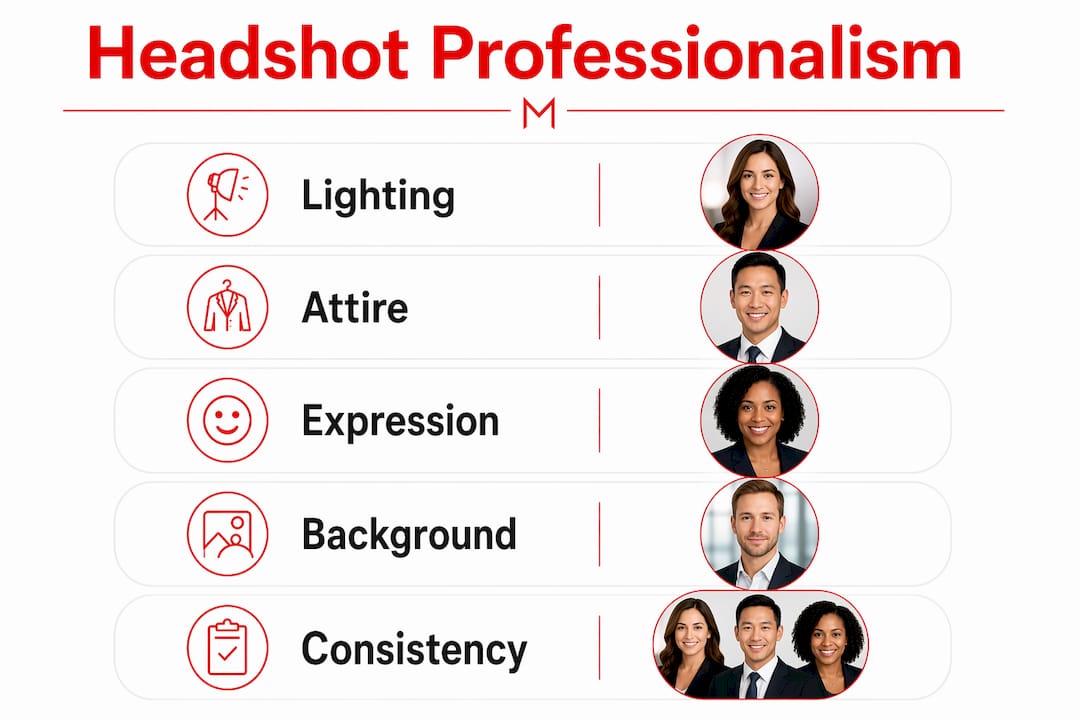
Lighting is the foundation. Soft, directional light defines facial structure while preserving natural skin texture. Harsh overhead or flat frontal lighting flattens features and creates an unflattering, passport-photo effect. Professional photographers use controlled light sources to shape the face in a way that photographs well at both full-size bio pages and small avatar crops.
Attire signals role and tone. Solid, mid-tone fabrics render predictably on camera. High-saturation colors and tight patterns can cause color clipping or visual distraction that pulls attention away from your expression. Coordinating wardrobe with your company’s primary or secondary colors creates subtle visual ties across a team page, especially against a neutral background.
Facial expression carries enormous weight. Psychological research on facial geometry and business portraits shows that business professionals tend to prefer faces that communicate trustworthiness over those projecting dominance. An open, confident expression with relaxed shoulders and a natural smile reads as both authoritative and approachable.
- Background: Neutral or brand-adjacent tones keep focus on the subject and provide clean separation for responsive web layouts.
- Framing: Eye line in the upper third of the frame, with a medium-tight crop, reads clearly at every size from LinkedIn thumbnail to annual report.
- Retouching: The goal is a well-rested, authentic version of you, not an altered composite. Texture preservation is non-negotiable.
Pro Tip: Before your session, pull up your company’s brand color palette and bring one or two wardrobe options that echo those tones. It takes two minutes of planning and creates visual cohesion that would otherwise require hours of post-production work.
Common headshot mistakes that undermine professionalism
Even well-intentioned headshots can quietly damage your brand image. These are the pitfalls that show up most often, and they are all avoidable.
- Inconsistent style across the team: Mixed lighting temperatures, varying backgrounds, and a blend of formal and casual attire create visual noise. Clients notice the inconsistency even when they cannot name it. Inconsistent corporate headshots signal disorganization, not diversity.
- Poor lighting: Harsh shadows under the eyes or chin, blown-out highlights on the forehead, or flat fluorescent light all read as unprofessional regardless of how polished the subject looks in person.
- Distracting backgrounds or clothing: Busy patterns, bold graphics, or cluttered environmental backgrounds pull the viewer’s eye away from your face. The background should support the subject, not compete with it.
- Over-retouching: Removing natural skin texture in pursuit of a flawless look backfires. Professional retouching outperforms self-managed editing precisely because experienced retouchers know where to stop. An over-smoothed face reads as artificial and erodes the authenticity that builds trust.
- Expressions that miss the mark: A forced smile looks forced. A flat, disengaged expression reads as arrogant or disinterested. Both undermine the approachability and confidence your brand needs to project.
- Outdated portraits: A headshot that no longer looks like you creates dissonance when clients meet you in person. That gap, however small, chips away at credibility.
How to make sure your headshot sends the right message
Getting a great headshot is not about luck. It is about preparation, clear communication with your photographer, and a commitment to consistency across your team.
Start with brand alignment. Pull your company’s style guide before the session and coordinate attire and background choices to match your brand’s color palette and tone. A financial services firm projects different values than a creative agency, and your headshot should reflect that distinction without requiring a caption to explain it.
Communicate your emotional goals to your photographer. Professional photographers recommend discussing whether you want to project authority, approachability, or a balance of both before the session begins. That conversation shapes every decision about pose, expression, and lighting angle.
- Coordinate attire and background to your brand’s color palette and professional tone.
- Brief your photographer on the emotional impression you want to create, authoritative, warm, or both.
- Standardize across your team with a written style guide covering lighting setup, background color, attire guidelines, and crop ratio.
- Update every 2–3 years, or sooner after a significant change in appearance or role visibility, as noted in corporate photography workflows.
- Request minimal, natural retouching that corrects exposure and removes temporary blemishes without erasing the texture that makes a face look real.
Pro Tip: Create a one-page headshot brief for your team before any group session. Include the background color, attire guidelines, and two or three reference images that capture the expression and tone you want. Photographers work faster and results stay consistent when everyone arrives with the same visual target.
What research and expert practice reveal about headshot psychology
The science behind headshot perception is more specific than most professionals realize. A study analyzing facial width-to-height ratio in business portraits found that professionals consistently prefer faces that communicate trustworthiness over those projecting dominance or success. That preference holds even in zero-acquaintance situations, meaning clients form these judgments from a single photograph with no prior context.
Professionally retouched headshots score significantly higher in perceived trustworthiness, confidence, and competence than self-retouched images. Research comparing retouching approaches found that photos handled by an experienced professional generated the best overall impressions across six key dimensions, including trustworthiness, competence, and likability. The target is always a well-rested, authentic version of the subject, with texture preserved so the image reads as human at high resolution.
Brand alignment between headshots and a company’s broader visual system, including typography, color, and layout, reinforces organizational credibility in ways that individual portraits alone cannot achieve. When portraits are planned for the brand system rather than treated as standalone assets, they strengthen identity rather than creating visual drift.
At Metroplex Headshots, this research informs every session. The approach centers on understanding each client’s brand environment and the emotional response they want to create, then building the technical decisions around that goal. The result is a portrait that works as hard as the professional it represents.
Where headshots work across your digital and offline brand
A professional headshot does not live in one place. It travels across your entire brand ecosystem, and its quality either reinforces or undermines your message at every touchpoint.

Digital placements include your LinkedIn profile, company website team page, email signature, speaker bios, press releases, and social media profiles. Each of these contexts presents your headshot at a different size and in a different visual environment. A portrait planned with the right crop ratio and negative space adapts cleanly across all of them without awkward cropping or loss of impact.
Offline placements carry equal weight. Annual reports, conference programs, pitch decks, trade publication profiles, and printed marketing collateral all feature headshots as part of your company’s visual identity. A portrait that looks polished on screen but prints poorly at high resolution creates a credibility gap exactly where you need to make a strong impression.
Corporate headshot standards account for both environments by specifying file formats, resolution targets, and color profiles that hold up across web and print. Planning for that range from the start saves time, reduces inconsistency, and keeps your brand looking cohesive wherever clients encounter it.
Key Takeaways
A professional headshot communicates company professionalism through consistent visual signals, and those signals shape client trust before any conversation begins.
| Point | Details |
|---|---|
| First impressions are visual | Attire, expression, and background drive snap judgments about competence and trustworthiness independent of actual performance. |
| Consistency builds brand credibility | Matching lighting, backgrounds, and attire across a team page signals organizational cohesion and professionalism. |
| Professional retouching outperforms self-editing | Experienced retouchers preserve skin texture and authenticity, producing higher scores in trustworthiness and competence. |
| Update portraits every 2–3 years | Regular refresh cycles keep headshots aligned with current appearance and brand standards, reducing visual dissonance. |
| Headshots integrate across every brand touchpoint | From LinkedIn to annual reports, portrait quality either reinforces or undermines your brand at every client encounter. |
Ready to put your best face forward?
Your headshot is one of the most cost-effective branding investments your company can make. At Metroplex Headshots, every session is built around your brand environment, your professional goals, and the impression you want to create. Whether you need a single executive portrait or a full team headshot program, the process is designed to deliver portraits that work as hard as you do.
Explore headshot session options or browse creative headshot examples to see what a well-executed portrait program looks like in practice. When you are ready to invest in your brand’s visual identity, Metroplex Headshots is ready to deliver.

